

| Quick answer: To become a web sleuth, learn open-source research basics (search operators, reverse image search, archiving), practice on low-risk projects, then join a moderated community or a structured program such as NamUs or Trace Labs. Use passive research only, and send what you find to investigators, never to social media. |
This guide is general information, not legal advice. Laws on harassment, privacy and private investigation vary by state.
Web sleuthing has a mixed record. Volunteers have helped put names to people who stayed unidentified for decades. Crowds of amateur detectives have also pinned crimes on innocent people, and in 2026 one of them was ordered to pay $10 million for it.
The difference usually comes down to three things: skill, where the work goes, and the rules the sleuth follows. This guide covers all three. You’ll learn the core skills and free tools, the step-by-step method investigators expect, the programs where volunteers can actually help, and the legal lines that get amateur sleuths into trouble.
What is a web sleuth?
A web sleuth is someone who researches unsolved crimes, missing and unidentified people, or viral claims using information that’s publicly available online. Most are volunteers. They read case files and news coverage, check photos and videos, search archives and public records, and pass useful leads to the people investigating.
Web sleuths aren’t private investigators, who are licensed and paid by clients, or journalists, who publish under editorial standards. Professionals who do the same kind of research for employers are usually called OSINT analysts. OSINT is short for open-source intelligence, meaning information anyone can legally access.
Which kind of web sleuth do you want to be?
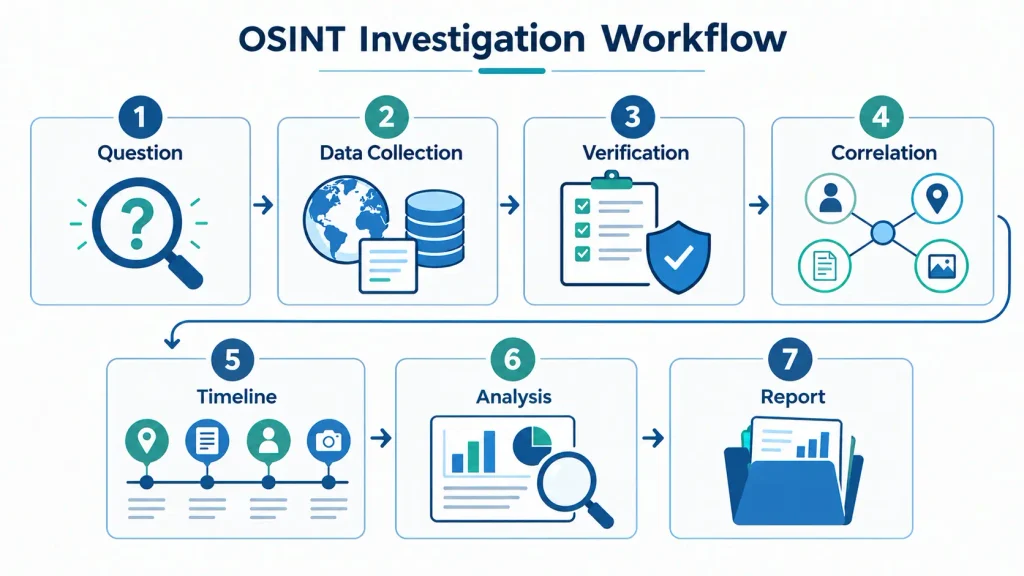
There are two realistic paths into web sleuthing, and they lead to different places.
| Volunteer path | Career path | |
| What you do | Help with missing-person and cold cases, and check viral claims | Research for companies, security teams, newsrooms or clients |
| Where you do it | Moderated forums, NamUs, Trace Labs events, genealogy projects | OSINT, threat intelligence, fraud and investigations roles |
| Time | A few hours a week | Full-time |
| Cost | Free tools are enough | Training and certification fees, plus a license if you investigate for paying clients |
| Where it leads | Leads for investigators, and sometimes an identification | A paid job and a portfolio of work |
Many people start on the volunteer path and move to the career path once they have experience and a track record.
Skills you need, and how to build each one
Good web sleuths are careful researchers first. These seven skills matter most, and each one can be practiced for free.
| Skill | What it means | Free way to practice |
| Advanced search | Using operators such as quotes, site: and filetype: to narrow results | Rebuild a news story’s timeline using only search operators |
| Image and video checking | Finding where a picture first appeared and whether it was edited | Reverse-search five viral images with Google Lens and TinEye |
| Geolocation | Working out where a photo or video was taken | Match street signs, shop fronts and landmarks against Google Street View |
| Archiving | Saving pages before they change or disappear | Save pages with the Wayback Machine’s Save Page Now |
| Evidence logs | Recording every source, URL and capture time | Keep a spreadsheet log for every practice project |
| Judging sources | Deciding how far to trust a source and a claim | Grade each source in your log using the method below |
| Writing a clean tip | Passing on facts, not theories | Rewrite a forum theory as a three-line, facts-only summary |
Patience matters as much as any of these. Most leads go nowhere, and that’s normal.
Your free starter toolkit, and each tool’s limits

You don’t need paid software to start web sleuthing. These free tools cover most beginner work, but each has limits worth knowing before you rely on it.
| Tool | Good for | Limits |
| Google search operators | Finding exact phrases, specific sites and file types | Results change over time, so log what you saw and when |
| Google Lens and TinEye | Finding other copies of an image and its earliest version | They miss images that were never indexed, and neither proves who took a photo |
| Wayback Machine | Seeing old versions of web pages and saving current ones | Not every page or date was captured |
| RDAP domain lookup | Checking when a domain was registered and with which registrar | ICANN made RDAP the official source for generic domains on 28 January 2025, replacing WHOIS. Owner details are usually not public |
| Google Street View history | Comparing how a place looked on different dates | Coverage and dates vary by location |
| County property records | Confirming who owns a property or business address | Records lag behind sales, and formats differ by county |
| Bellingcat’s Online Investigations Toolkit | A free directory of research tools, sorted by task | It’s a directory, not a method. You still have to verify every result |
Face search sites such as PimEyes need extra care. Running a stranger’s face through one raises consent and privacy problems, and laws such as Illinois’ Biometric Information Privacy Act regulate how biometric data like face geometry is collected and used.
Paid people-search sites are another trap. Their records are often out of date or mixed up with someone else’s, and the law limits what you can use them for, as the legal section below explains.
How to investigate, step by step
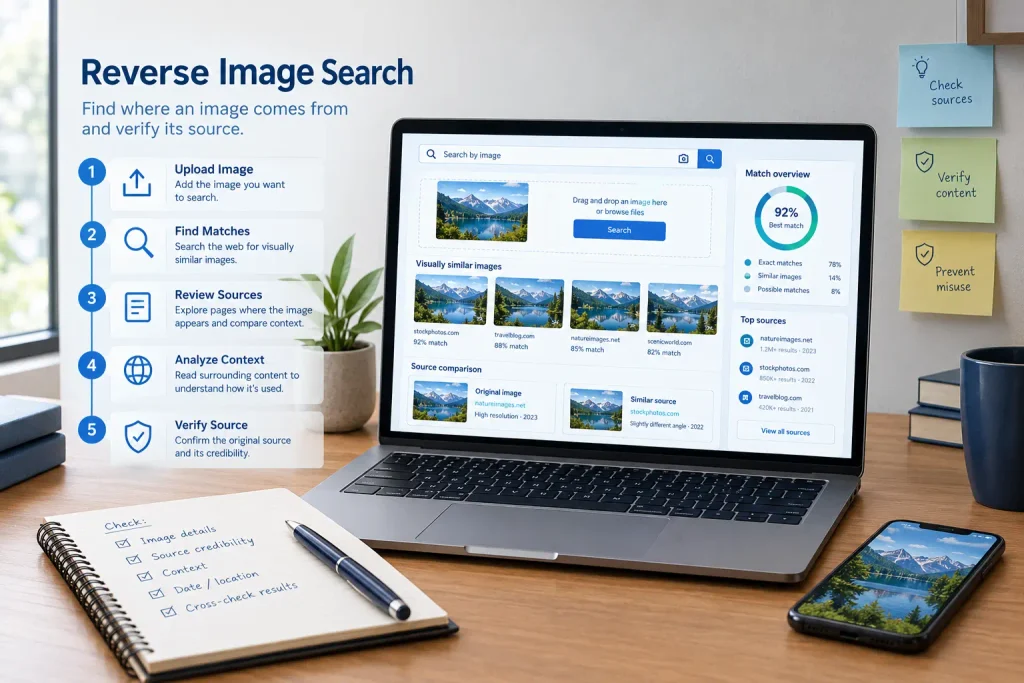
A good investigation follows the same order every time, so someone else can check your work.
- Define the question. Write it in one sentence, such as “Where was this photo taken?” A narrow question keeps you from drifting.
- Collect with passive methods only. Read, search and view. Don’t message anyone, create fake profiles or try to get into accounts.
- Archive and log everything. For each source, save the URL, an archived copy, a screenshot, and the date and time you captured it.
- Verify with at least two independent sources. Two posts that copy the same original count as one source.
- Grade your sources. Many analysts use the Admiralty code. It rates the source with a letter from A (completely reliable) to F (reliability can’t be judged) and the information with a number from 1 (confirmed) to 6 (truth can’t be judged).
- Build a timeline and a link chart. A spreadsheet works: one row per event with its date, source and grade, plus a simple map of how people, places and accounts connect.
- Report what you found, not what you think. Facts, sources and gaps go to investigators. Theories stay in your notes.
Worked example: checking a viral photo
Say a photo claims to show flooding in a city yesterday. Reverse-search it in Google Lens and TinEye and look for the oldest match. If the same image appeared online years ago, the claim is false. If it’s genuinely new, compare street signs and buildings against Street View to confirm the location, check weather records for that date, and archive every page you used.
Your finding is then one sentence plus sources, for example: “This image first appeared online in 2019,” followed by the archived link.
Where you can actually help
Some of the most useful web sleuthing happens inside structured programs that already work with law enforcement.
| Organization | What volunteers do | Key rules |
| NamUs (National Missing and Unidentified Persons System) | Run by the National Institute of Justice. Members of the public can register, enter missing-person cases and search public case details | Every public case entry is vetted with the investigating agency before it’s published |
| Trace Labs Search Party | Team events, with up to four people per team, that collect open-source leads on real missing-person cases for law enforcement | Passive research only, no contact with anyone connected to the case, and no sharing case details afterward |
| DNA Doe Project | A nonprofit volunteer group that uses genetic genealogy to identify unidentified people for law enforcement | Volunteer work centers on genealogy research. Contact the project to ask about volunteering |
| Websleuths forum | A long-running online forum for missing-person and cold-case discussion | Read the rules first, cite mainstream news sources, and never contact victims’ families |
| Reddit communities | Case discussion and geolocation groups | Each community sets its own rules on naming people. Read them before posting |
The DNA Doe Project shows what careful volunteer work can achieve. In 1981, a young woman was found dead in a ditch in Troy, Ohio, wearing a distinctive buckskin coat. She stayed unidentified for 37 years. In 2018, the project’s volunteers used genetic genealogy, working with law enforcement, to identify her as Marcia King of Arkansas.
If you’re new to Websleuths, longtime members suggest starting in the Missing Persons or Cold Cases sections and reading for a while before you post.
The rules: what web sleuths must never do
Trace Labs publishes clear rules for its volunteers, and they work as a code of conduct for any web sleuth.
Never:
- Contact the missing person, their family or their friends by message, call or friend request
- Try to log in to accounts, reset passwords or test whether an email address has an account
- Post case details, names or screenshots publicly
- Name a suspect online, even in a “just asking questions” post
- Confront anyone or visit a scene to investigate
Always:
- Use passive research only: reading, searching and viewing public information
- Keep an evidence log with archived links and timestamps
- Send findings to the investigating agency or the program you’re working with
- Follow each community’s rules. Websleuths, for example, doesn’t allow members to contact victims’ families
What’s legal, and where sleuths get into trouble
Reading and searching public information is legal. Problems start when sleuths accuse people, get into accounts or harass anyone.
Defamation
In November 2022, four University of Idaho students were killed. A TikTok creator then claimed, based on tarot readings, that a university professor was behind the murders. The professor sued. In June 2024, a federal magistrate judge ruled the claims defamatory, finding no objective basis for them. In early 2026, a federal jury in Boise awarded the professor $10 million, including $7.5 million in punitive damages.
Saying someone committed a crime without proof can cost far more than your reputation.
Getting into accounts
Logging in to someone’s account, guessing a password or using a password-reset trick can break federal law, including the Computer Fraud and Abuse Act, as well as state computer crime laws. Good intentions aren’t a defense.
Harassment, stalking and doxxing
Publishing someone’s home address or repeatedly contacting them can count as harassment or stalking. Laws vary by state, and some states have passed laws aimed specifically at doxxing.
People-search data
Information from people-search sites can’t be used to make decisions about hiring, housing or credit unless the site follows the Fair Credit Reporting Act. In 2012, Spokeo paid $800,000 to settle Federal Trade Commission charges that it marketed consumer profiles for employment screening without following that law.
Getting paid
If you investigate for paying clients, you’re working as a private investigator. The U.S. Bureau of Labor Statistics notes that most states require private investigators to be licensed, so check your state’s rules first.
When sleuthing helps and when it hurts: real cases
Well-documented cases show both sides of web sleuthing, and the pattern is consistent: structured, evidence-based work helps, while public speculation hurts.
Boston Marathon bombing, 2013
After the bombing, Reddit users and others tried to identify the bombers from crowd photos. They publicly named a missing college student who had nothing to do with the attack. Reddit later issued a public apology for the online witch hunt. The lesson: a resemblance in a photo is not evidence.
The murder of Missy Bevers, 2016
Fitness instructor Missy Bevers was killed at a church in Midlothian, Texas, in April 2016. Facebook groups with hundreds of members built theories around her relatives, friends and class members. One former person of interest had their home address shared online, and people police had cleared were still targeted. By early 2017, police had received about 1,300 to 1,400 tips, most based on speculation rather than fact. The lesson: speculation floods investigators and harms innocent people.
Buckskin Girl, identified in 2018
The identification of Marcia King, described above, came from volunteers working inside a structured program, alongside law enforcement, using verifiable DNA evidence. Nobody was named in public before the facts were confirmed. The lesson: the most useful sleuthing is quiet, careful and connected to investigators.
How to send a tip investigators can use
A useful tip is short, factual and easy to check. Send it through an official channel:
- The investigating agency first. Most missing-person posters and press releases list a contact.
- The FBI for federal cases, through tips.fbi.gov or 1-800-CALL-FBI.
- The case contact on NamUs for missing and unidentified person cases.
Use this simple format:
| Case: [name or case number] What I found: [one or two sentences, facts only] Where: [live URL] and [archived URL] When I captured it: [date, time and time zone] Why it may matter: [one sentence] My contact details: [name, email, phone] |
Leave out theories, opinions and anything you can’t link to a source.
Protect yourself while you sleuth
Web sleuthing exposes you to strangers, upsetting material and people who don’t want to be found, so set up some protection before you start.
- Use a separate username. Don’t use your real name or your everyday accounts on case forums.
- Know what a VPN does and doesn’t do. A VPN hides your browsing from your internet provider, and the sites you visit see the VPN’s address instead of yours. It doesn’t stop sites, search engines or the accounts you’re logged in to from recording what you do, and the VPN company can see your traffic instead.
- Shrink your own footprint. Search your own name and remove what you can from people-search sites. California residents can use the state’s free DROP platform to send one deletion request to every registered data broker. Brokers have had to start processing those requests from August 1, 2026.
- Protect your mental health. Cases can involve graphic images and heavy stories. Set time limits (Trace Labs suggests moving on after about an hour with no results), take breaks, and step back if a case starts to affect your sleep or mood.
Can you turn web sleuthing into a career?
Yes, you can turn web sleuthing into a career, but the paid version usually goes by another name: OSINT, investigations or threat intelligence.
- Roles: OSINT analyst, threat intelligence analyst, fraud investigator, due diligence researcher and private investigator.
- Training: the SANS SEC497 course (Practical Open-Source Intelligence) and the related GIAC Open Source Intelligence (GOSI) certification are well known in the field.
- Licensing: client investigation work usually needs a state private investigator license.
- Pay and outlook: the median annual wage for private detectives and investigators was $51,220 in May 2025, and employment is projected to grow 5 percent from 2025 to 2035, according to the Bureau of Labor Statistics.
- Portfolio: Trace Labs results and documented verification projects (without sensitive case details) show employers what you can do.
AI and web sleuthing: new risks
AI tools can speed up research, but they also create new ways to get things wrong.
- Fake or edited images. AI can generate realistic photos and alter real ones. Look for an earlier original before you trust any image.
- False face matches. Face search tools return confident-looking matches that can be wrong, especially with blurry or low-quality images. A match is a lead to check, never an identification.
- Invented facts. AI chatbots can produce names, dates and sources that don’t exist. Never pass on a claim you can’t trace to an original source.
Your first 30 days as a web sleuth

A simple four-week plan gets you from zero to useful without touching a live case too early.
- Week 1: Learn search operators, Google Lens, TinEye and the Wayback Machine. Start your evidence-log spreadsheet.
- Week 2: Pick one community, read its rules, and read without posting.
- Week 3: Check three viral images or claims from start to finish using the step-by-step method above.
- Week 4: Register on NamUs, sign up for a Trace Labs event, or contribute to an approved project in your community.
FAQs
Do web sleuths get paid?
Most web sleuths are volunteers and don’t get paid. Paid work in this field usually goes by titles such as OSINT analyst, investigator or threat intelligence analyst, and investigating for clients often requires a state private investigator license.
Is web sleuthing legal?
Web sleuthing is legal when you research public information and pass your findings to investigators. It becomes illegal when you get into accounts without permission, harass or stalk people, or publish false accusations.
Do I need paid tools to become a web sleuth?
You don’t need paid tools to become a web sleuth. Free tools such as Google search operators, Google Lens, TinEye and the Wayback Machine cover most beginner work, and paid people-search sites add little while coming with legal limits.
How do I start web sleuthing with no experience?
To start web sleuthing with no experience, learn the free tools, read one moderated community for a few weeks, and practice on viral-image checks before you work on a real case.
Can web sleuths work with the police?
Web sleuths can help the police by sending factual, sourced tips through official channels, or by working inside programs such as Trace Labs and NamUs that already partner with law enforcement. Don’t contact families or witnesses yourself.
The bottom line
Becoming a web sleuth is less about clever tricks than about discipline: research carefully, document everything, follow the rules, and hand your findings to the people who can act on them. Start with the free tools, practice on low-risk projects, and join a program that already works with investigators. Done that way, your work can help a case instead of hurting one.
Sources
- National Institute of Justice, NamUs
- Trace Labs, Search Party participant guide
- DNA Doe Project, Buckskin Girl case
- ICANN, Launching RDAP; Sunsetting WHOIS (27 January 2025)
- Bellingcat, Online Investigations Toolkit (September 2024)
- Moscow-Pullman Daily News, TikTok accusations against UI professor ruled defamatory (June 2024)
- Idaho Education News, U of I professor receives $10 million award in defamation case (March 2026)
- Dallas Observer, Internet Sleuths Muddy Waters and Wreck Lives in Missy Bevers’ Murder Investigation (January 2017)
- Federal Trade Commission, Spokeo settlement (June 2012)
- U.S. Bureau of Labor Statistics, Occupational Outlook Handbook: Private Detectives and Investigators
- California Privacy Protection Agency, Delete Request and Opt-out Platform (DROP)
- SANS Institute, SEC497 and GIAC GOSI