
When thinking about the automotive industry, most individuals see images of assembly lines, factories and showrooms. But the warehouse is not part of the image that comes to mind. Yet a modern car has more than 40,000 parts coming from a number of different suppliers and without the proper inventory, nothing else matters.
The underlying sector in the industry is quite big now. This paper will examine the size of the sector, the factors that drive its growth, the role of technology and regulation in its development, and the risks associated with the forecast.
The Forecast at a Glance
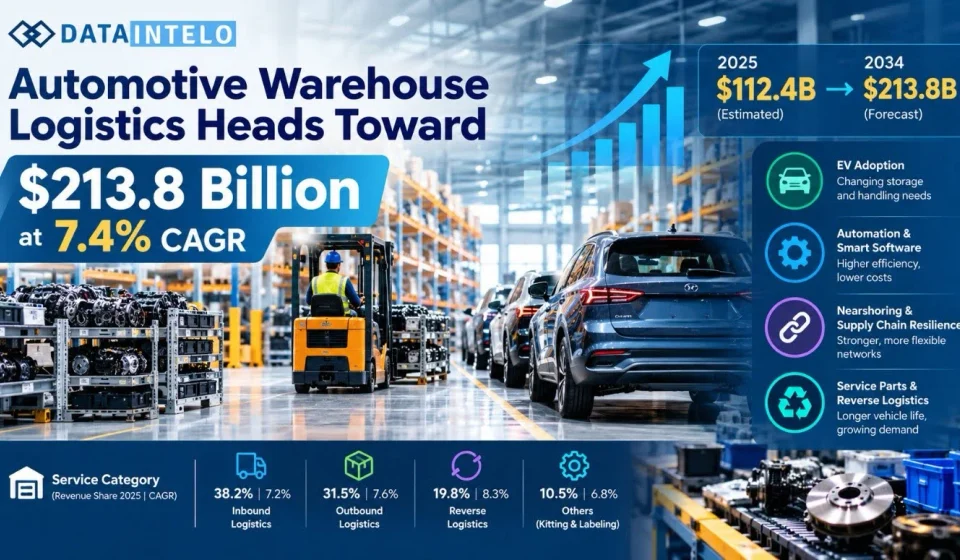
Based on the predictions made by Dataintelo, automotive warehouse logistics was estimated to have a value of $112.4 billion in 2025 and is forecast to grow to $213.8 billion by 2034 at a compounded annual growth rate (CAGR) of 7.4%.
These are only predictions by analysts and should be taken as such, and the figures in all the following paragraphs are taken from the same forecast unless stated otherwise.
Current State of the Sector
The logistics operations in the automotive sector encompass more than just the storage activities. This includes the inbound logistics of suppliers’ components, outbound logistics of service parts, reverse logistics that involve warranties and battery collection, among other activities.
| Service category | Revenue share 2025 | CAGR |
| Inbound logistics | 38.2% | 7.2% |
| Outbound logistics | 31.5% | 7.6% |
| Reverse Logistics | 19.8% | 8.3% |
| Others (Kitting & Labeling) | 10.5% | 6.8% |
Inbound logistics accounts for the greatest revenue share because the assembly plants operate on the concepts of just-in-time and just-in-sequence, meaning the parts should be delivered in the same sequence as they are required on the production line. The discrepancy between reverse logistics growth and size is telling of what’s to come in the industry.
Growth Factor 1: The Shift to Electric Vehicles
The emergence of electric cars will affect the physical specifications of the warehouse. The high voltage battery pack can weigh anywhere from 300 kilograms to 700 kilograms. It requires regulated temperature and humidity control, fire fighting system for lithium-ion thermal runaway, and special handling training of the staff.
EVs comprised an estimated 20.1% of the revenue from the sector in 2025 and are expected to record an average annual growth rate of 9.6%, which is the highest among all types of vehicles. Their share is estimated to reach about 30% by 2034. Also, it is estimated that the operators are investing about $14 billion per year in EV compatible infrastructure.
In reality, capability in handling the batteries is becoming one of the considerations in selecting logistics providers by automotive companies when implementing EV projects.
Growth Factor 2: Automation and Smarter Software
Labour is expensive and hard to procure in many automobile centres, which makes operators opt for automation. AS/RS is the biggest segment of technology, contributing to 44.6% of revenue attributed to technology in 2025 and is expected to have 9.2% CAGR. AS/RS installations in new and retrofitted automotive warehouses increased by 18% in 2024.
Software is equally fast-paced. WMS is accounting for around 36.8% of the revenue generated by technology and 62% of new automotive WMS implementations in 2025 are in cloud, up from 29% in 2020. Cloud system has the capacity to scale during the launch of a new model without any on-premises upgrade.
According to the report, fully implemented WMS will help lower inventory holding costs by 18-24%. This percentage is just a benchmark and varies according to the site.
Growth Factor 3: Nearshoring and Supply Chain Resilience
It was an expensive lesson for everyone in 2021-2022 due to semiconductor shortage. According to forecasts, it is linked to over $210 billion in lost automotive sales. From 2021 to 2025, carmakers planned investments of $420 billion into manufacturing, largely intended for production near end customers.
Any new factory requires warehousing facilities in its proximity. At the same time, the business model is changing. The average contract duration between manufacturers and logistics companies has risen from three years in 2019 to over five years in 2025. It gives providers the visibility necessary for investments in automation technology, but also obligates both parties for a longer period of time.
Growth Factor 4: Service Parts and Reverse Logistics
The global fleet of vehicles surpassed 1.5 billion in 2025 and cars are being driven for a longer period than before. The average car age in the US is 12.6 years, in Europe 12.1 and 7.8 in China. Old vehicles require many repairs and therefore there is a continuous need for warehousing operations that can distribute repair parts in 24-48 hours.
However, the other new trend in automotive logistics is reverse logistics. With the first wave of EV batteries reaching the end of their lifecycle, collection, transportation, evaluation, and recycling of these batteries have become a separate logistics operation. It is expected that by 2030, battery reverse logistics may be worth around $12.4 billion a year. However, special certification and facilities are needed for the process.
Regional Outlook
| Region | Share of 2025 revenue | Projected CAGR |
| Asia Pacific | 38.6% | ~8.1% |
| North America | 27.3% | 7.1% |
| Europe | 22.4% | 6.8% |
| Latin America | 6.8% | 6.3% |
| Middle East & Africa | 4.9% | 7.8% |
It leads the region thanks to its high concentration of vehicle manufacturers, where China alone holds the first spot in terms of production. India has to be monitored, since the level of third-party logistics penetration in Indian automotive logistics is around 33%, while that of Germany exceeds 65%. Furthermore, schemes like the Production Linked Incentive keep attracting investments. In North America, new plants are setting up shop in Mexican industrial clusters thanks to nearshoring.
Regulatory Developments
Regulation impacts warehouse logistics indirectly yet significantly.
- Battery regulation. The inclusion of battery passports and recycled materials in batteries results in an increased need for traceability and reverse logistics under the EU Battery Regulation.
- Industrial policy. Legislation such as the Inflation Reduction Act and the CHIPS and Science Act has directed the investment in manufacturing sites in certain regions and thus the location of warehouse investments. This projection includes over $95 billion of investments until early 2026. The US incentive policy changes, and therefore, one should check the existing policies before basing a business case on a specific tax credit.
- Emission targets. However, the 2035 goal for new combustion engine cars set by the EU creates future forecasts for electric cars, although the pace and specifics of implementation depend on politics.
- Fire and safety codes. Lithium-ion battery storage regulations affect building design, insurance conditions, and site selection.
Since the rules may be changed more quickly than one can rebuild the structure, flexibility is an effective safety measure for warehouse design.
Case Studies and Industry Developments
A few examples of how the above trends are manifesting themselves are:
- DHL Supply Chain has over 1,900 automotive facilities in more than 60 countries. The AutoStore-based parts centers that DHL has in Germany and South Carolina had a throughput increase of up to 60% per square foot as compared to standard operation centers. The company announced a commitment of EUR 3.8 billion towards automation and electric vehicle logistics in January 2025.
- Kuehne + Nagel uses a combination of AS/RS and digital-twin design of warehouses in its projects in Poland, Slovakia and Mexico.
- In 2024-2025, BMW and Continental used vehicle telematics in testing a predictive parts positioning solution in which high-demand parts would be prepositioned at regional centers ahead of the filing of warranty claims.
The five largest companies in terms of revenue (DHL Supply Chain, XPO Logistics, Kuehne + Nagel, Ceva Logistics and DB Schenker) have a revenue market share of about 31.4%, a fairly concentrated market share. Regional players are strong in markets such as Japan, China and Brazil.
Emerging Technologies
There are several technologies that are transitioning from piloting to widespread implementation:
- Autonomous mobile robots (AMRs) for goods-to-person picking, designed for locations where the installation of an AS/RS system is not justified.
- Digital twin simulation of a warehouse layout prior to any investment in the system.
- IoT and RFID monitoring for real-time traceability within the multilevel supplier network.
- AI demand forecasting, one of the technology groups expected to see annual growth of around 8.1%.
- Predictive parts placement using connected vehicle information.
Implementation is normally done through integration with the current WMS and ERP software.
Challenges and Risks
- Cyclicality. The high fixed cost nature of warehouses means that any reduction in car manufacturing has an immediate impact, as witnessed in 2023-2024.
- Capital intensity. Technology requires increased investment while reducing the returns from existing manual facilities.
- Scarcity of labour. The existence of hard-to-replace labor forces hastens automation; however, the process is very costly and risky.
- Geopolitical changes. Any change in tariffs or geopolitics could immediately affect the demand curve without consideration for any previous agreement on a long-term basis.
Key Factors to be Considered by Decision-Makers
- Warehouse type: specialized warehouses constitute 45.3%, whereas multiple client warehouses have been increasing at the fastest rate at 7.8%.
- Specialisation: EV handling and battery reverse logistics require features that traditional facilities do not have.
- Flexibility: Both the contract and the building should have enough flexibility that would permit future modifications.
- Foreseeability limitations: Each and every forecast is an interval in its own right, and future growth will depend on EVs, policies, and the production cycle.
Conclusion
The increase from $112.4 billion in 2025 to forecasted $213.8 billion in 2034 depends upon certain fundamentals, which include electrification, automation, nearshoring, and aging fleet of vehicles. The speed at which the industry reaches that point will be based on the speed at which it adapts its infrastructure and operations amidst the cyclic nature of automotive manufacturing.