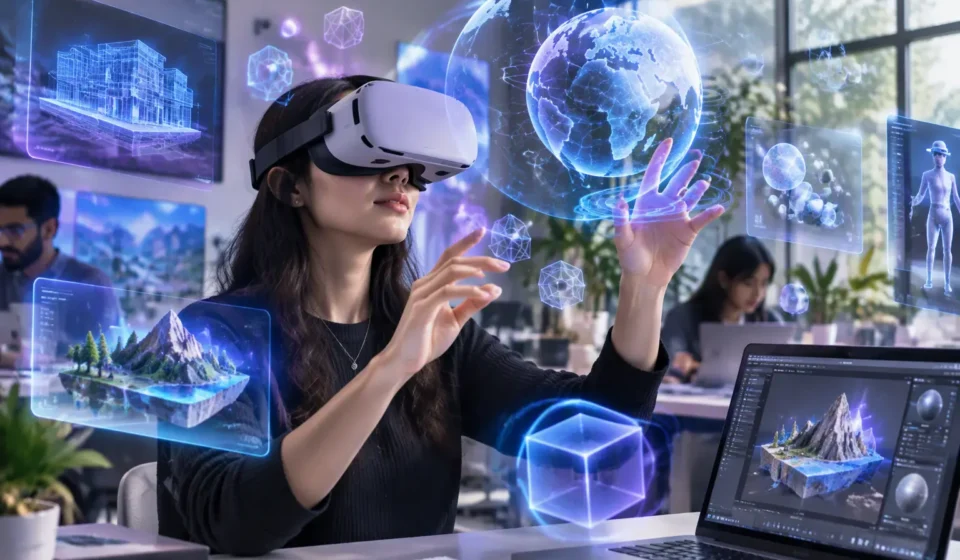

There have been a lot of changes brought about by immersive technology that are making people experience digital content in a different way. For example, instead of viewing the information on a screen, it is now possible for digital objects, information and experiences to be presented in the physical world.
For those students who wish to pursue a career in this emerging field, an AR VR course may offer them a framework for learning how immersive experiences are built. The students will be taught the artistic and technological aspects of AR, along with developing their skills in fields like immersive design, programming, spatial interaction, and digital content creation.
Understanding the World of Immersive Technology
Before embarking on an AR career, it is vital to be familiar with the wider world of immersive technologies. AR, VR, extended reality, gaming, immersive storytelling, and interactive media are related fields.
Augmented reality improves on the physical world by adding digital components that the user sees and interacts with via compatible devices. Virtual reality constructs a digital world where the user can have a more immersive experience.
Through structured augmented reality courses, learners can understand the differences between these technologies while exploring how immersive experiences are planned, designed, and developed.
This broader perspective can help learners understand where their interests lie and which skills they need to develop for their preferred career direction.
Developing Technical Skills for AR Development
Every immersive experience is the result of collaboration between software development, design, digital content, and interactions technology. Professional should know about these elements and their relationship.
Learning path for AR can include the following topics: programming, interaction development, applications development, immersive environments, and real time development.
Understanding these fields is especially useful since working within the realm of immersive technology means that one has to approach things differently than when developing applications normally. Not only must they take into account what will be seen on the screen, but also how digital elements will interact with the physical environment.
Learning Three Dimensional Content Creation
Immersion technology depends on visual immersion. Therefore, creating three-dimensional digital content is crucial for individuals who would like to become experts in AR and VR.
The students have a chance to acquire knowledge about how digital items are created for immersive purposes. They could also get familiar with visual composition, positioning, animation, and interactivity.
The objective goes beyond developing aesthetically pleasing digital components. Designers need to consider how such components would act in the immersive space and how people would interact with them.
This blend of design and knowledge can be a significant asset in pursuing careers in immersive technologies.
Building Skills for Immersive Experiences
An ar vr course can help learners develop a combination of technical, creative, and problem solving capabilities. Important skill areas may include:
- Understanding augmented reality and virtual reality concepts
- Creating interactive and immersive digital experiences
- Developing three dimensional content and environments
- Understanding spatial design and user interaction
- Building knowledge of real time development
- Exploring immersive storytelling and experience design
Together, these abilities can provide a foundation for understanding how immersive applications move from an initial idea to an engaging digital experience.
Understanding User Experience in AR
The mere use of technology is not enough to create an immersive application. How the technology is experienced and interacted with by people is as important.
In designing augmented reality, the designer must take into consideration movement, visibility, interaction, space, accessibility, and usability. People should be able to figure out what they can do in an experience without being disoriented.
As such, it is even more important for anyone hoping to be an AR professional in the future. The learner will start to appreciate the concept of how technology should react to human behavior, and not the other way round.
It is possible to develop a mindset which can lead to a career between design, technology, product development, and immersive experiences.
Exploring Immersive Storytelling
The development of immersive technology is not only a matter of technological development. It is equally relevant to have an idea on how to create stories that are engaging and relevant.
Unlike traditional forms of digital content, it becomes possible in immersive technology for people to be able to interact directly with space and with content in general.
Understanding the process of integrating narrative thinking with immersive technology is important for individuals interested in creative work, games, media, learning, and interaction.
Developing a Problem Solving Mindset
Being involved in immersive technology requires problem solving all the time. Developers and designers have to consider many aspects of interaction between digital content and the physical/virtual environment as well as the interaction itself.
A well-structured curriculum may help learners think about these issues in an organized way. Instead of concentrating on individual tools, learners can understand the thinking process behind immersive design and development.
This is relevant since immersive technologies are constantly advancing. People that have a knowledge of core concepts will be better positioned to cope with changes within this field.
Preparing for Careers in Immersive Technology
The interdisciplinary nature of AR and VR can lead learners toward different career directions. Depending on their skills and interests, they may explore roles connected with:
- AR and VR application development
- Immersive experience design
- Three dimensional content creation
- Gaming and interactive media
- Extended reality development
- Immersive product and experience development
Understanding these areas can help learners identify which aspect of immersive technology aligns most closely with their interests and strengths.
Conclusion
Augmented Reality involves technology, innovation, design, and interaction with humans. A career in the field of Augmented Reality, therefore, involves more than merely getting familiar with one development language. It involves having an understanding of what is involved in conceiving, designing, developing, and experiencing immersive experiences.
This is something that can be done with an ar/vr course, which can introduce students to immersive development, spatial design, 3D content, interaction, games, story telling, and real time applications. Augmented Reality courses, when designed properly, could also be very useful for professionals to understand the bigger picture of immersive technology.
With the proper blend of knowledge, creativity, and continued learning, professionals will be able to prepare themselves to engage in the developing world of immersive technologies.