
Kaliscan is most commonly known as a Docker-based cybersecurity scanning toolkit used for network reconnaissance, vulnerability detection, and penetration testing. A separate platform sharing the same name also operates as a free online manga and manhwa reading site. This article covers both — in full.
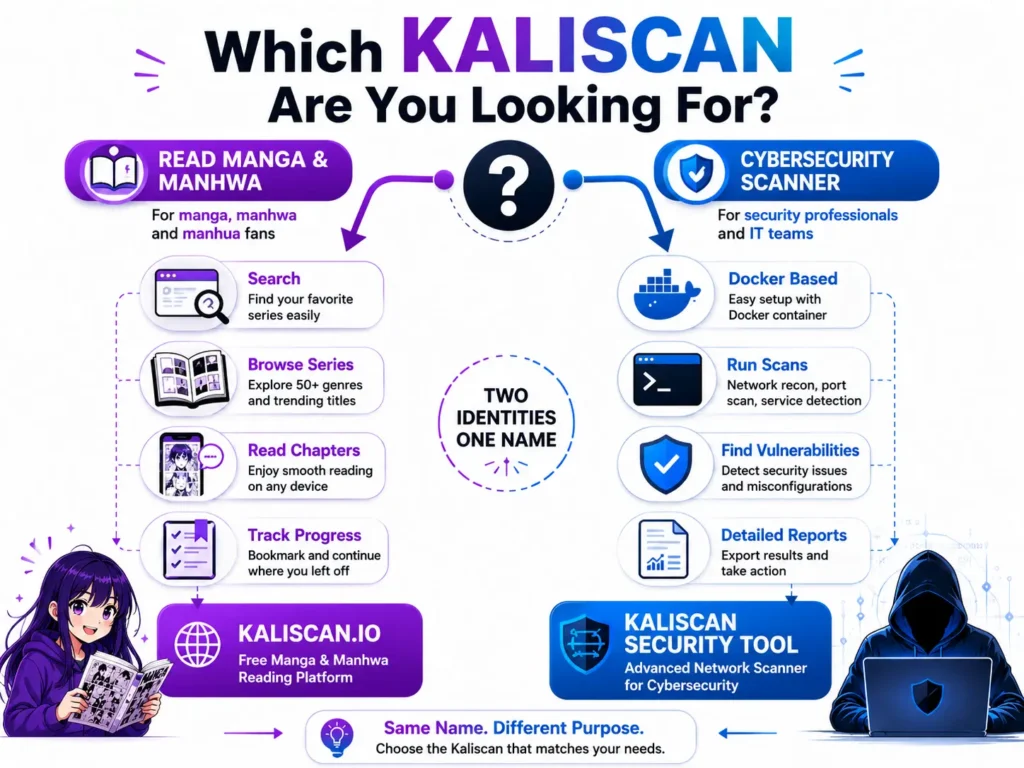
If you have searched for “Kaliscan” and landed in two very different places — one a security tool, the other a manga reading website — you are not alone. The name carries two distinct identities online, and understanding which one you are dealing with depends entirely on context.
The name itself is a clue about the security tool’s origins. “Kali” is a direct nod to Kali Linux, the industry-standard operating system for penetration testing and ethical hacking. “Scan” refers to the active reconnaissance and detection processes that sit at the heart of what the tool does. Together, the name signals a purpose-built scanner rooted in the Kali Linux ecosystem.
Kaliscan as a Manga & Manhwa Reading Platform {#reading-platform}
What is Kaliscan.io?
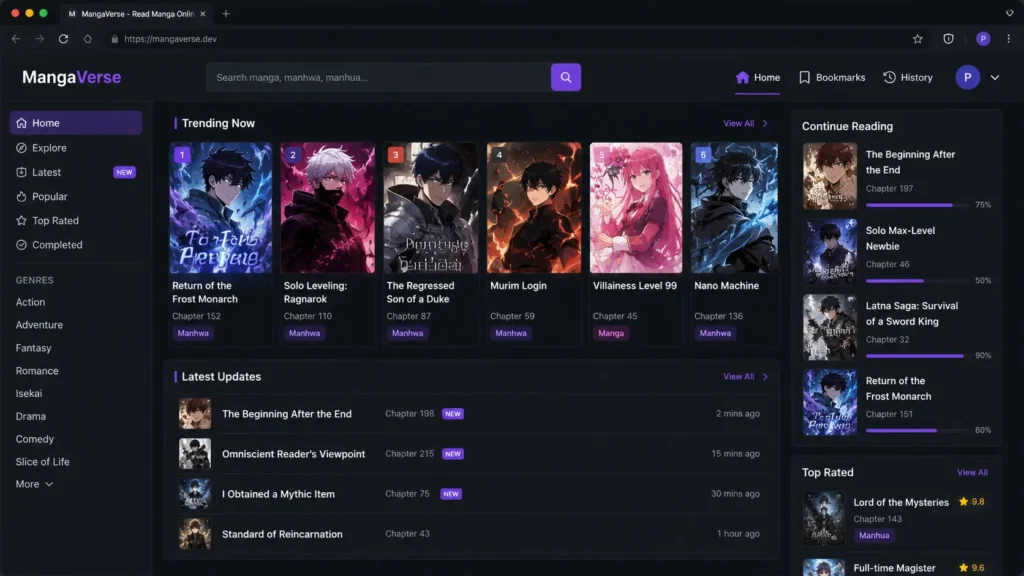
Kaliscan.io is a free, browser-based reading platform for manga (Japanese comics), manhwa (Korean comics), and manhua (Chinese comics). No app download is required. No account registration is needed for basic reading access — open a browser, search for a title, and start reading immediately.
The platform operates as a scanlation aggregator. It collects fan-translated chapters produced by volunteer communities and makes them available in one searchable library spanning more than 50 genre categories. Popular genres include action, fantasy, romance, isekai, horror, slice-of-life, BL (Boys’ Love), GL (Girls’ Love), and adult categories.
Two features consistently draw readers to Kaliscan over competing aggregators:
- Update speed: New chapters often appear within hours of their original release — faster than most alternatives.
- Library breadth: The platform covers both mainstream blockbuster titles and niche series that licensed platforms do not carry in English.
The platform has historically operated across multiple domains — kaliscan.io, kaliscan.me, kaliscan.com, and others — because content aggregators periodically face ISP-level blocking in certain countries and legal pressure from publishers. When one domain goes down, the platform migrates to an alternative address. Readers typically locate the current active domain via Reddit’s r/manga or r/manhwa communities, where updated links appear quickly.
Who Is Kaliscan Built For?
The security tool serves several distinct user groups, each with slightly different use cases.
Penetration testers and red teams use Kaliscan for initial reconnaissance during engagements. It provides a fast lay of the land — open ports, exposed subdomains, vulnerable service versions — before deeper exploitation work begins.
SMB IT security teams benefit from a tool that bridges the gap between basic network monitoring and enterprise-grade vulnerability management platforms. For organizations that cannot staff a dedicated security function, Kaliscan provides a structured, repeatable scanning capability without requiring deep specialist knowledge to operate.
Cybersecurity students and bootcamp learners encounter Kaliscan as a practical training tool. Its use alongside Kali Linux fundamentals makes it a natural companion for anyone building hands-on penetration testing skills.
Network and cloud administrators use it for scheduled monitoring — particularly useful in cloud-native environments where infrastructure is dynamic and the attack surface shifts regularly.
How to Use Kaliscan.io — A Walkthrough

Using the platform is straightforward. Here is the end-to-end flow:
1. Search for a title Use the search bar at the top of the page. Enter a series name, author name, or genre keyword. Results return a series card showing genre tags, publication status (Ongoing / Completed / Hiatus), and chapter count.
2. Select your series Click the series card to open its chapter list, sorted newest-first by default.
3. Choose a reading format Manhwa and manhua titles use vertical infinite scroll — the standard webtoon format that works naturally on mobile. Traditional Japanese manga uses horizontal page-by-page navigation.
4. Handle missing chapters If a chapter fails to load or is missing from the library, search the title and chapter number directly on Google. Alternative aggregator sites almost always host the same chapter.
5. Track your progress Without an account, reading progress is not saved between sessions. Creating a free account — where the feature is available — allows bookmarking series and tracking the last chapter read.
Tip for mobile readers: The vertical scroll format renders well in any mobile browser. No app installation is needed or recommended.
Is Kaliscan.io Safe?
This is the most common question from readers who discover the platform. The answer requires separating two distinct risk layers.
The site itself: Low risk Multiple independent security analysis tools have assessed kaliscan.io as low-risk for malware and phishing. The domain uses Cloudflare infrastructure and standard SSL certification. Kaliscan.io ranks among the top 10,000 websites globally by traffic volume — a signal of an established, non-ephemeral presence rather than a fly-by-night operation.
The ad network: Requires caution Free platforms generate revenue through advertising, and the quality of ad networks on aggregator sites varies significantly. Kaliscan’s ad network can serve misleading download buttons, fake “install to continue” prompts, or unexpected redirect pages. These do not come from Kaliscan itself — they come from third-party ad partners the platform uses to monetize traffic.
This is the actual risk, not the platform.
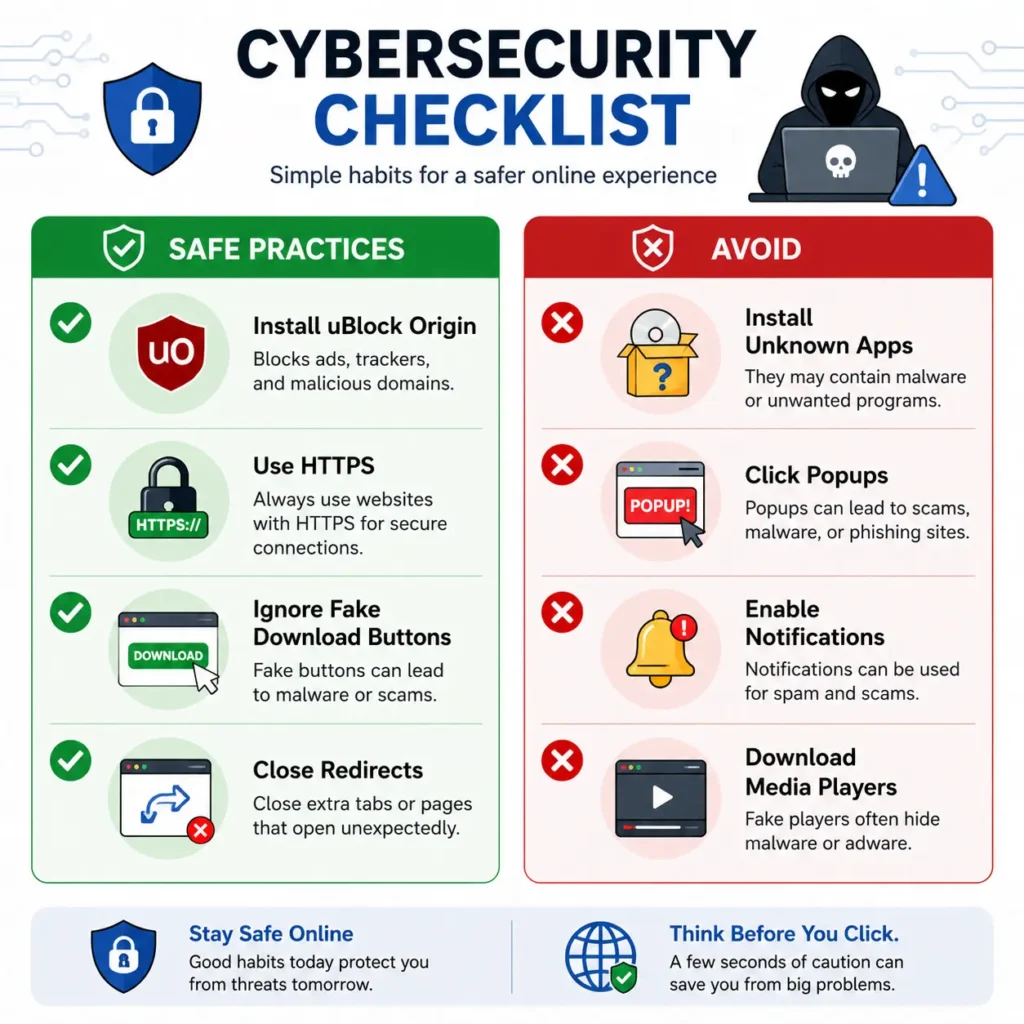
How to use Kaliscan.io safely:
- Install uBlock Origin (free browser extension, available for Chrome, Firefox, and Edge) before visiting. This blocks the large majority of intrusive ad behavior.
- Never click any button that asks you to download software or install a media player.
- If a page redirects unexpectedly, close it and return via the back button. Do not interact with whatever it opened.
The site is not a scam. The ads surrounding it require caution.
Legal Status of Kaliscan.io
Kaliscan operates as a scanlation aggregator — a platform that distributes fan-translated content without licensing agreements from the publishers who own distribution rights. This places it in a legal grey area that is worth understanding before using it regularly.
Major rights holders include Shueisha (publisher of Weekly Shonen Jump and titles such as One Piece and Jujutsu Kaisen), Kakao Entertainment (a major Korean manhwa publisher), and LINE Corporation, which operates the Webtoon platform. None of these publishers have authorized Kaliscan to distribute their content.
In practical terms: reading a title on Kaliscan that has an official licensed English release — on Viz Media, Manga Plus, or Webtoon — constitutes copyright infringement by the reader in most jurisdictions, even though no payment is involved. The legal risk to individual readers is low in practice, but it is not zero.
The cleaner alternative: For titles with official English releases, licensed platforms are free to read with ads:
- Manga Plus by Shueisha — free access to current chapters of major Jump titles at release time
- Webtoon — the primary official platform for manhwa, fully free with ads
- Viz Media — official English publisher for the Shonen Jump catalog
Official versions support the creators directly. Aggregators do not.
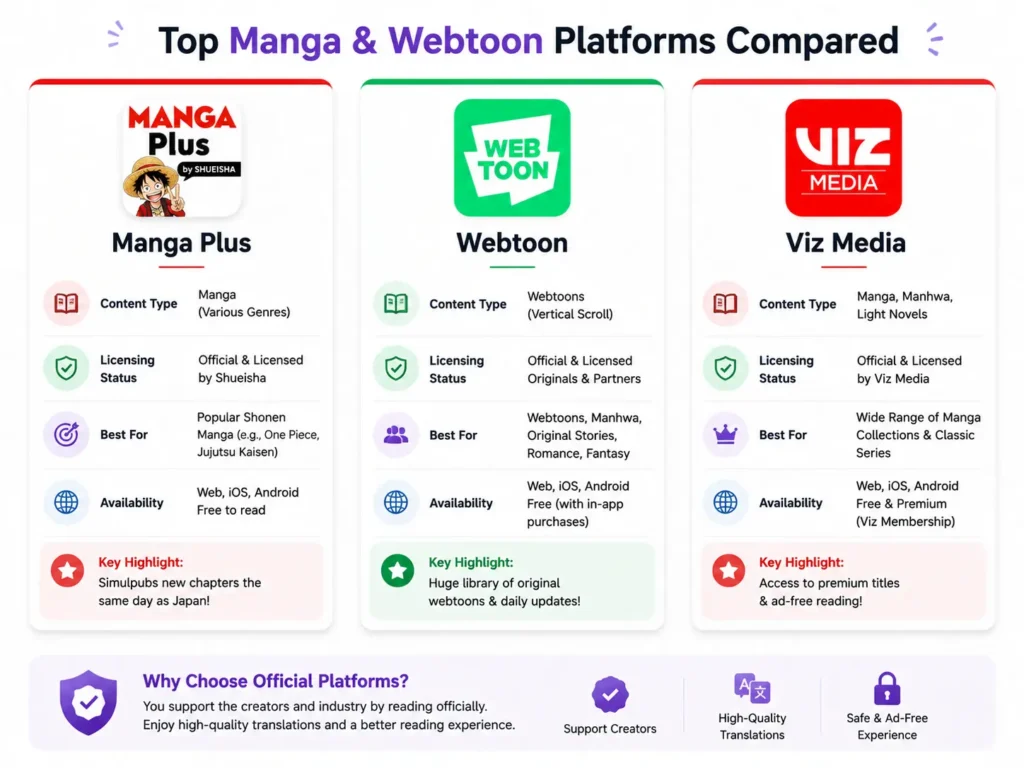
Kaliscan Alternatives for Manga & Manhwa Readers
If Kaliscan.io is unavailable, blocked, or you want a legally cleaner reading option, the following alternatives cover the same intent:
Free & officially licensed
Manga Plus by Shueisha Free access to the first and last three chapters of most Jump titles. Full access to ongoing series at time of release. Best for: One Piece, Jujutsu Kaisen, My Hero Academia, Chainsaw Man.
Webtoon The primary official platform for Korean manhwa. Full library available free with ads, with official translations. Best for: Tower of God, Lore Olympus, True Beauty, The Beginning After the End.
Viz Media Official English publisher for major Shonen Jump titles. First chapters are free; subscription unlocks the full catalog.
Free aggregators (similar model to Kaliscan)
MangaDex Scanlation aggregator with stronger community moderation and significantly less intrusive advertising than most aggregators. Does not host every title but is generally the safer ad-environment choice.
MangaKakalot / MangaReader Broader libraries, similar aggregation model to Kaliscan — faster updates but heavier ad load.
Aggregator availability changes frequently. Search the series title + “read online free” for current active sources if a specific site is down.
Kaliscan as a Cybersecurity Scanner {#security-tool}
What Exactly is Kaliscan? (Security Tool)
In the cybersecurity world, Kaliscan is a lightweight, Docker-containerized scanning toolkit built for network reconnaissance and vulnerability detection. It is used by penetration testers, ethical hackers, and IT security teams who need a fast, repeatable way to map attack surfaces without standing up complex infrastructure.
At its core, Kaliscan is a reconnaissance and vulnerability scanning solution designed to identify weaknesses in digital systems before attackers can exploit them. It is built around the idea of giving security professionals — whether working in enterprise IT, freelance penetration testing, or red team operations — a tool that balances depth of analysis with ease of deployment.
The toolkit is containerized using Docker, which means it runs in an isolated, reproducible environment. There are no complicated dependencies to resolve, no version conflicts to manage. You pull the container, configure your target, and run the scan. This architecture also makes it straightforward to integrate into CI/CD pipelines or automate as part of a broader DevSecOps workflow.
Where Kaliscan sits in the broader tooling landscape is worth understanding. Compared to Nmap, which excels at raw network discovery and port scanning, Kaliscan adds a higher-level vulnerability analysis layer on top of that reconnaissance data. Compared to Nessus, which offers polished enterprise reporting and deep compliance auditing, Kaliscan sits in a more accessible, lightweight middle ground — powerful enough for real-world assessments, but approachable for teams without a dedicated security headcount.
Kaliscan is also scriptable. Security teams can extend its default behavior by integrating custom bash or Python scripts, making it a natural fit for organizations that already have established security automation workflows. The output is not just raw terminal data either — the tool generates visual reports structured for clarity, meaning findings can be shared with non-technical stakeholders without a translation layer.
Who is Kaliscan built for?
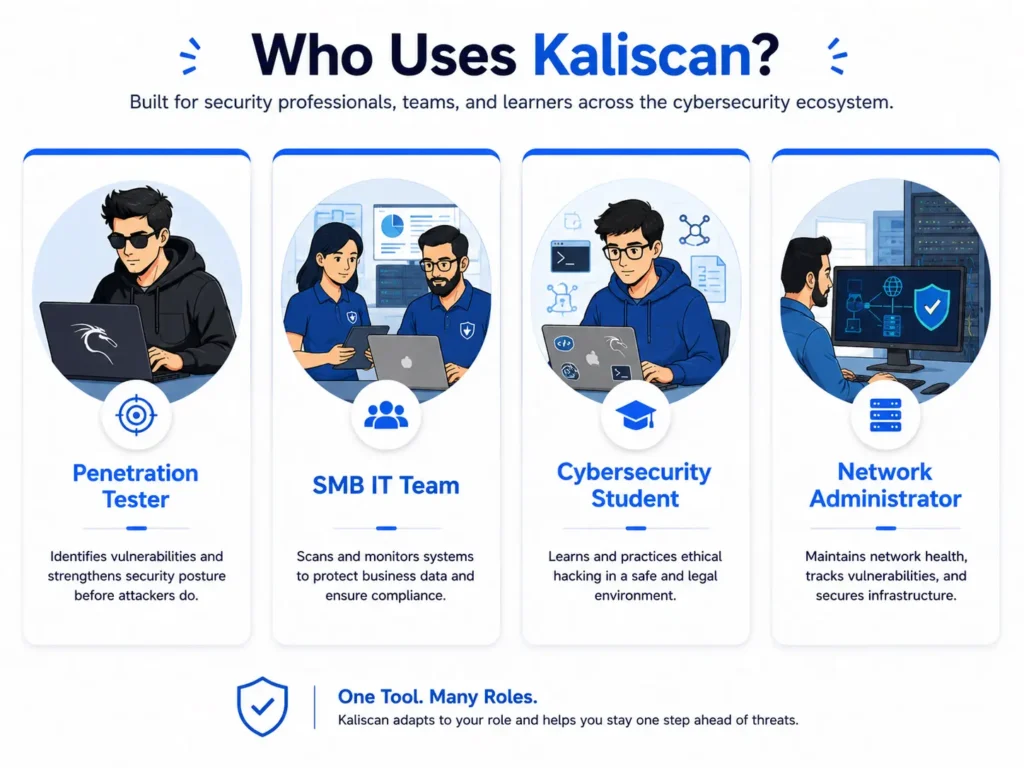
The security tool serves several distinct user groups, each with slightly different use cases.
Penetration testers and red teams use Kaliscan for initial reconnaissance during engagements. It provides a fast lay of the land — open ports, exposed subdomains, vulnerable service versions — before deeper exploitation work begins.
SMB IT security teams benefit from a tool that bridges the gap between basic network monitoring and enterprise-grade vulnerability management platforms. For organizations that cannot staff a dedicated security function, Kaliscan provides a structured, repeatable scanning capability without requiring deep specialist knowledge to operate.
Cybersecurity students and bootcamp learners encounter Kaliscan as a practical training tool. Its use alongside Kali Linux fundamentals makes it a natural companion for anyone building hands-on penetration testing skills.
Network and cloud administrators use it for scheduled monitoring — particularly useful in cloud-native environments where infrastructure is dynamic and the attack surface shifts regularly.
How to Install and Run Kaliscan
The published article describes what Kaliscan’s Docker architecture does but stops short of explaining how to actually deploy it. This section closes that gap.
Prerequisites: Docker installed on your host machine. Docker Desktop covers Mac and Windows; Docker Engine is the standard for Linux hosts.
Basic installation and first scan:
# Pull the Kaliscan container image
docker pull kaliscan/scanner:latest

# Run a quick scan against a target IP or domain
docker run --rm kaliscan/scanner:latest scan \
  --target <IP_OR_DOMAIN> \
  --mode quick

# Run a full scan and export the report to a local folder
docker run --rm -v $(pwd)/reports:/reports kaliscan/scanner:latest scan \
  --target <IP_OR_DOMAIN> \
  --mode full \
  --output /reports/scan-report.html
CI/CD pipeline integration: Because Kaliscan runs as a Docker container, it can be called as a pipeline step in GitHub Actions, GitLab CI, or Jenkins without installing software on the CI runner. This is one of the primary reasons Docker-based architecture is preferred over agent-based scanners in DevSecOps workflows — the container spins up, scans, outputs a report, and exits cleanly.
⚠️ Authorization required. Running Kaliscan against unauthorized targets is illegal under computer crime legislation in most jurisdictions regardless of intent. Always confirm written authorization before scanning.
Verify the current image tag from the official Kaliscan repository before running — image tags and command syntax may update between releases.
How Kaliscan Works — Step by Step
Understanding the mechanics of Kaliscan helps both new adopters and experienced practitioners use it more effectively. The workflow follows a logical progression from target definition through to remediation-ready reporting.
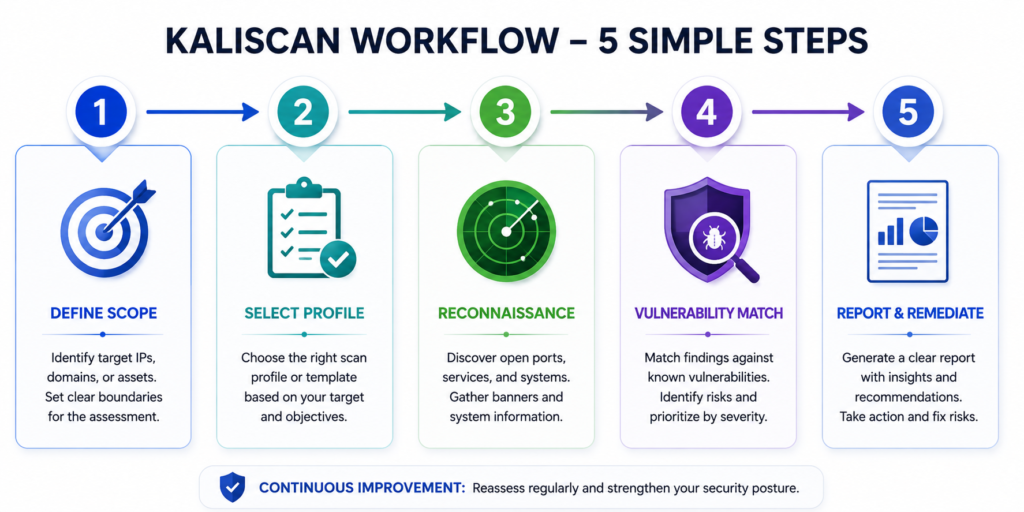
Step 1 — Define the target scope
Every scan begins with scope definition. Kaliscan accepts individual IP addresses, domain names, IP ranges (CIDR notation), or bulk input files listing multiple targets. Getting the scope right matters: too narrow and you miss exposure; too broad and you generate noise that buries real findings.
For most engagements, the scope is defined in coordination with the asset owner. Running Kaliscan against systems you do not have explicit authorization to test is illegal in most jurisdictions — this point is non-negotiable regardless of your technical intent.
Step 2 — Select a scan profile
Kaliscan offers three primary scan modes:
- Quick scan — a surface-level sweep covering common ports and known vulnerability signatures. Ideal for initial reconnaissance or time-constrained engagements.
- Full scan — a comprehensive assessment that checks the complete port range, enumerates subdomains, inspects SSL/TLS certificates, and runs a deeper vulnerability database match. Takes longer but returns a more complete picture.
- Targeted scan — a focused run against a specific service, port, or application layer. Useful when you already know where you want to look and need precision over breadth.
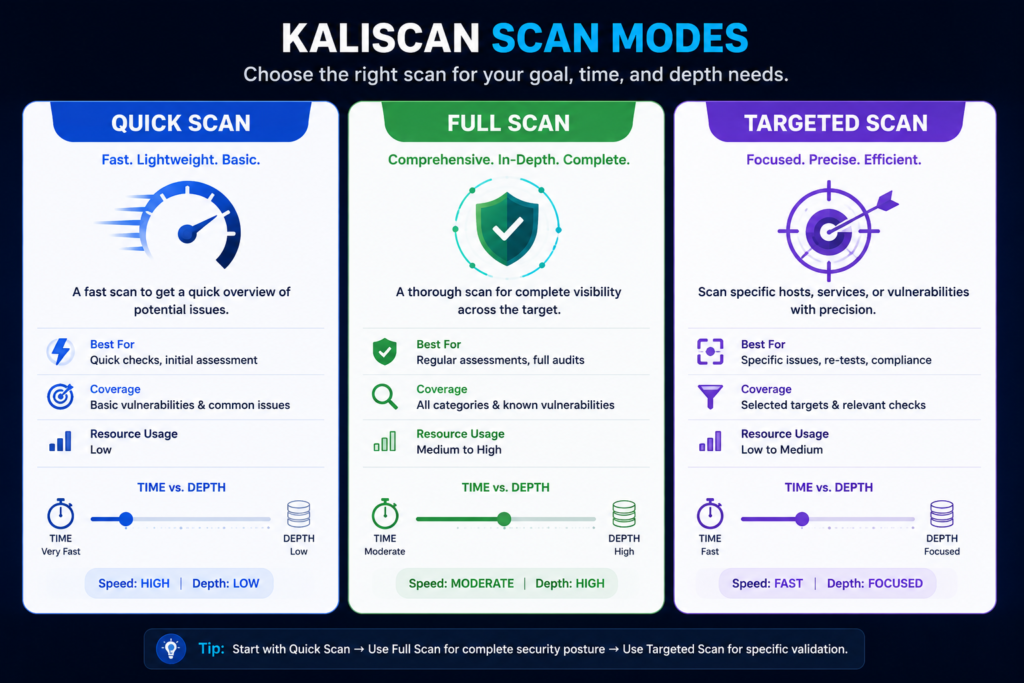
Custom scan profiles can be saved and reused, which is particularly valuable for teams running recurring assessments against the same environments — cloud infrastructure with dynamic IP ranges, for example, benefits from a configured profile that can be triggered automatically.
Step 3 — Reconnaissance and enumeration
During an active scan, Kaliscan performs several reconnaissance tasks in parallel. These include subdomain enumeration (discovering subdomains that may expose additional attack surface), open port discovery across defined ranges, SSL certificate inspection (checking for expiry, misconfiguration, or weak cipher suites), and service version detection (identifying what software is running on each exposed port).
This phase is where the Docker-containerized architecture pays dividends — the scan runs cleanly without polluting the host environment, and results are logged in a structured format for downstream processing.
Step 4 — Vulnerability database matching
Once reconnaissance data is collected, Kaliscan cross-references it against several vulnerability sources. This includes CVE (Common Vulnerabilities and Exposures) listed defects, OWASP Top 10 web application vulnerabilities, and anomaly patterns associated with zero-day or undisclosed threats.
The zero-day detection capability uses AI-assisted pattern recognition to flag behavior that deviates from expected baselines — a useful layer of defense even when a specific CVE entry does not yet exist for a newly discovered weakness. No scanner can guarantee 100% zero-day detection, and Kaliscan makes no exception, but the heuristic layer meaningfully extends coverage beyond static database lookups.
Step 5 — Reporting and remediation handoff
Kaliscan generates structured visual reports that prioritize findings by risk severity. High-risk issues surface first; informational findings are separated from actionable vulnerabilities. This structure matters in practice — a report that dumps everything at equal weight forces the reader to triage manually, wasting time.
The reports are designed to be legible to both security engineers and business stakeholders. An engineering team gets the technical detail they need to patch; a CISO or IT manager gets a risk summary they can act on without parsing raw scan output.
For ongoing monitoring, Kaliscan supports scheduled scans. A monthly cadence is the recommended minimum for most environments. Weekly scans are advisable for cloud-native workloads, dynamic IP environments, or systems handling sensitive data. Running a scan immediately before any significant system update is also good practice — it establishes a clean baseline and surfaces any pre-existing vulnerabilities before change introduces additional complexity.
At its core, Kaliscan is a reconnaissance and vulnerability scanning solution designed to identify weaknesses in digital systems before attackers can exploit them. It is built around the idea of giving security professionals — whether working in enterprise IT, freelance penetration testing, or red team operations — a tool that balances depth of analysis with ease of deployment.
The toolkit is containerized using Docker, which means it runs in an isolated, reproducible environment. There are no complicated dependencies to resolve, no version conflicts to manage. You pull the container, configure your target, and run the scan. This architecture also makes it straightforward to integrate into CI/CD pipelines or automate as part of a broader DevSecOps workflow.
Kaliscan vs Nmap vs Nessus vs OpenVAS
Where Kaliscan sits in the broader tooling landscape is worth understanding. Compared to Nmap, which excels at raw network discovery and port scanning, Kaliscan adds a higher-level vulnerability analysis layer on top of that reconnaissance data. Compared to Nessus, which offers polished enterprise reporting and deep compliance auditing, Kaliscan sits in a more accessible, lightweight middle ground — powerful enough for real-world assessments, but approachable for teams without a dedicated security headcount. For small to mid-sized businesses that cannot justify enterprise-tier tooling costs, this balance is often exactly what they need.
OpenVAS (Greenbone Community Edition) is the fourth common reference point practitioners use when evaluating Kaliscan. Like Kaliscan, OpenVAS is free and open-source. Unlike Kaliscan, it is significantly more complex to set up and maintain — it requires manual vulnerability feed updates, more configuration overhead, and familiarity with the Greenbone interface. Where OpenVAS excels is compliance-grade output: it includes CIS benchmark scanning and PCI-DSS templates that Kaliscan does not currently offer. For teams that need audit-trail reporting for compliance purposes, OpenVAS is the better fit. For teams that want fast, deployable, reproducible scans without configuration overhead, Kaliscan’s Docker model has a clear advantage.
Comparison at a glance:
| Kaliscan | Nmap | Nessus | OpenVAS | |
|---|---|---|---|---|
| Cost | Free | Free | $3,390/yr | Free (Community) |
| Setup complexity | Low (Docker pull) | Low | Medium | High |
| Scan depth | Medium-High | Port/service only | Very High | High |
| Compliance reporting | No | No | Yes | Yes |
| CI/CD integration | Native (Docker) | Scriptable | Limited | Limited |
| GUI available | No (in development) | Yes (Zenmap) | Yes | Yes |
The other Kaliscan — online manga and manhwa reader
For completeness, the second identity of the Kaliscan name deserves acknowledgment.
Kaliscan.io is a free, browser-based reading platform for manga (Japanese), manhwa (Korean), and manhua (Chinese) comics. Readers can search a title, open a chapter, and begin reading immediately — no account registration or subscription required. The platform has attracted significant traffic, reportedly exceeding 51 million visits in a single month, with an average session duration of around 32 minutes, reflecting how deeply readers engage when mid-series.
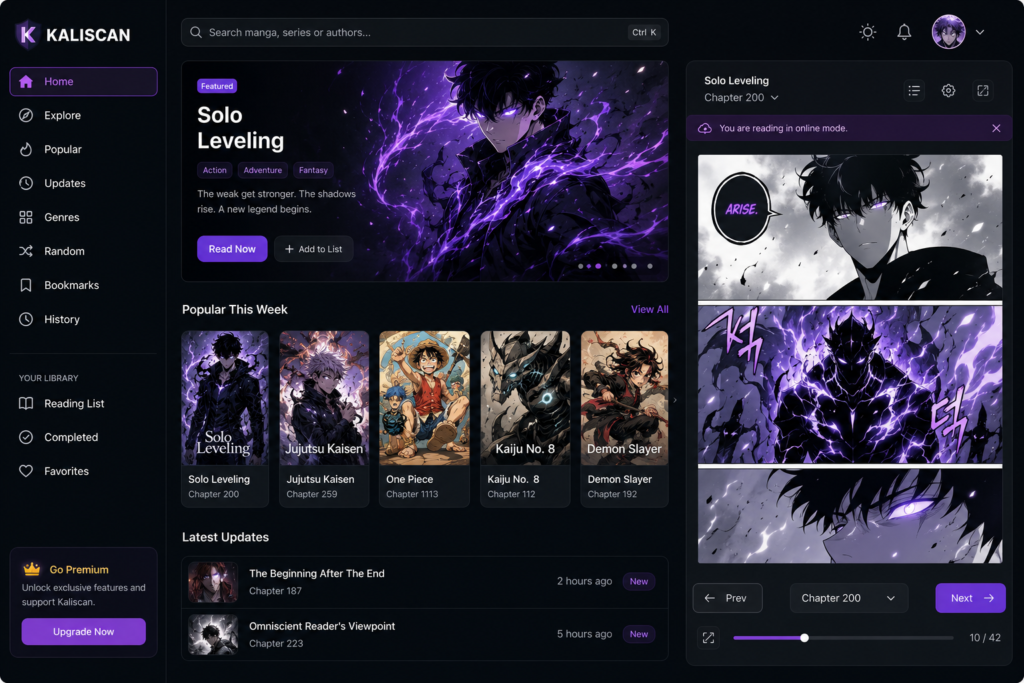
The platform works as a scanlation aggregator — it hosts fan-translated chapters rather than officially licensed content. This places it in a legal grey area, as the content is not distributed with publisher authorization. Readers using the platform should be aware of this distinction.
From a technical standpoint, the reading experience is straightforward: search returns series listings with genre tags and status labels (Ongoing or Completed). Selecting a series opens a chapter list; chapters render as vertically scrolling image sequences for manhwa, or horizontal page-by-page navigation for traditional manga format.
The relevance to a technical audience is primarily navigational — if a search for “Kaliscan” returns reading platform results when you were looking for the security tool, now you know why.
Verify the current image tag from the official Kaliscan repository before running — image tags and command syntax may update between releases.
Kaliscan vs Nmap vs Nessus vs OpenVAS
Where Kaliscan sits in the broader tooling landscape is worth understanding. Compared to Nmap, which excels at raw network discovery and port scanning, Kaliscan adds a higher-level vulnerability analysis layer on top of that reconnaissance data. Compared to Nessus, which offers polished enterprise reporting and deep compliance auditing, Kaliscan sits in a more accessible, lightweight middle ground — powerful enough for real-world assessments, but approachable for teams without a dedicated security headcount. For small to mid-sized businesses that cannot justify enterprise-tier tooling costs, this balance is often exactly what they need.
OpenVAS (Greenbone Community Edition) is the fourth common reference point practitioners use when evaluating Kaliscan. Like Kaliscan, OpenVAS is free and open-source. Unlike Kaliscan, it is significantly more complex to set up and maintain — it requires manual vulnerability feed updates, more configuration overhead, and familiarity with the Greenbone interface. Where OpenVAS excels is compliance-grade output: it includes CIS benchmark scanning and PCI-DSS templates that Kaliscan does not currently offer. For teams that need audit-trail reporting for compliance purposes, OpenVAS is the better fit. For teams that want fast, deployable, reproducible scans without configuration overhead, Kaliscan’s Docker model has a clear advantage.
Comparison at a glance:
| Kaliscan | Nmap | Nessus | OpenVAS | |
|---|---|---|---|---|
| Cost | Free | Free | $3,390/yr | Free (Community) |
| Setup complexity | Low (Docker pull) | Low | Medium | High |
| Scan depth | Medium-High | Port/service only | Very High | High |
| Compliance reporting | No | No | Yes | Yes |
| CI/CD integration | Native (Docker) | Scriptable | Limited | Limited |
| GUI available | No (in development) | Yes (Zenmap) | Yes | Yes |
Core features of Kaliscan
A quick reference of what the tool brings to a security workflow:
Multi-platform coverage. Kaliscan targets on-premise networks, web applications, cloud environments (AWS, GCP, and Azure), IoT devices, and mobile applications on both iOS and Android. A single tool covering this range reduces the overhead of managing multiple scanners for different asset classes.
Scriptable and extensible. Custom bash or Python scripts can be integrated directly into scan workflows. Teams with existing automation pipelines can wire Kaliscan into their toolchain rather than running it in isolation.
Visual stakeholder reporting. Output is not limited to terminal logs. The reporting layer produces structured, visual summaries appropriate for sharing with non-technical decision-makers.
AI-assisted anomaly detection. Pattern recognition flags suspicious behavior that may indicate zero-day or novel threats, extending coverage beyond static CVE and OWASP database matching.
Containerized architecture. Docker-based deployment means clean, repeatable scans without dependency conflicts or environment contamination. Well-suited to CI/CD integration and DevSecOps workflows.
Limitations to know. The interface is currently command-line only — there is no native GUI, which may present a steeper learning curve for less experienced users. A GUI version is reportedly in development. Plugin support is also more limited compared to mature enterprise tools like Nessus or Burp Suite. For deep compliance auditing that requires exhaustive, audit-trail-grade reporting, those tools remain better suited. Kaliscan’s strength is in its accessibility and speed, not in replacing purpose-built compliance scanners.
The Other Kaliscan: Manga & Manhwa Reader (Brief Reference)
For readers who arrived here looking for the manga and manhwa reading platform — Kaliscan.io — the complete guide to what it is, how to use it, whether it is safe, its legal status, and the best alternatives is covered in Section A at the top of this article. Jump back up using the navigation links at the introduction.
Final thoughts
Kaliscan occupies a useful middle ground in the vulnerability scanning landscape — accessible enough for teams without large security budgets, capable enough for professional penetration testing workflows, and flexible enough to extend through custom scripting. Its Docker-based architecture removes a common barrier to adoption, and its reporting layer makes findings actionable for both technical and non-technical audiences.
Whether you are a network administrator setting up recurring cloud environment scans, a penetration tester building out a red team toolkit, or a security student working through hands-on Kali Linux labs, Kaliscan is a tool worth understanding.
If you landed here looking for the manga reading platform instead — now you know that exists too, and why the two share a name.
Frequently asked questions about Kaliscan
Is Kaliscan free to use?
The security toolkit is open-source and free. There are no licensing fees for core scanning functionality. The reading platform is also free to access, though the legal status of its content differs from the security tool.
Can Kaliscan detect zero-day vulnerabilities?
It uses AI-assisted pattern recognition to flag anomalous behavior that may indicate novel or undisclosed threats. No scanner provides guaranteed zero-day detection, but this heuristic layer extends coverage beyond static CVE databases.
How does Kaliscan compare to Nessus and Nmap?
Nmap is a raw network discovery tool — fast and highly customizable but focused on port and service enumeration rather than vulnerability analysis. Nessus offers deep enterprise-grade vulnerability management with polished compliance reporting but comes with significant licensing costs. Kaliscan sits between the two: more analytical than Nmap, more accessible and cost-effective than Nessus, and well-suited to teams that need a balance of depth and usability.
Is Kaliscan legal to use?
As a security tool, yes — when used on systems you own or have explicit written authorization to test. Running Kaliscan against unauthorized targets is illegal under computer crime legislation in most countries, regardless of intent.
How often should I run a Kaliscan scan?
Monthly is the recommended minimum for most environments. Weekly is advisable for high-risk, cloud-native, or rapidly changing infrastructure. Pre-update scans are a recommended best practice before any significant system change.
Can non-technical users operate Kaliscan?
The current interface is command-line only, which creates a learning curve for users without a technical background. The reporting output is designed to be readable by non-technical stakeholders, but running the tool itself requires comfort with CLI workflows. A GUI version is in development.
What manga and manhwa genres does Kaliscan.io cover?
Kaliscan.io covers more than 50 genre categories. The most active sections are action, fantasy, romance, isekai (parallel world stories), horror, slice-of-life, BL (Boys’ Love), and GL (Girls’ Love). Adult categories including smut, yaoi, and yuri are available but typically sit behind age confirmation prompts. The platform covers all three major comic traditions in one interface — Japanese manga, Korean manhwa, and Chinese manhua — without requiring separate searches across different sites.
Why is Kaliscan.io not working, or showing a different domain?
Kaliscan operates across multiple domains — kaliscan.io, kaliscan.me, kaliscan.com, and others — because content aggregators periodically face ISP-level blocking in certain countries and legal pressure from publishers. When a primary domain goes down, the platform typically migrates to an alternative address without notice. The fastest way to find the current active domain: search “kaliscan” on Reddit’s r/manga or r/manhwa communities. Readers post updated links quickly when the primary domain changes, and pinned posts in those communities usually carry the latest working address.
Can I use Kaliscan.io on mobile?
Yes. Kaliscan.io works in any mobile browser without a dedicated app. The reading interface adapts to mobile screen sizes — manhwa and webtoon-format titles render as vertical infinite scroll, which suits mobile reading naturally. If the mobile browser experience is slow or unresponsive, clearing the browser cache or switching browsers (Chrome vs. Safari vs. Firefox) usually resolves it. No official iOS or Android app is available; any app claiming to be Kaliscan in an app store should be treated with caution.


