

VPN.ht is a Hong Kong-based VPN service originally built for Popcorn Time and P2P users. It offers AES-256 encryption, a claimed no-log policy, and a Five Eyes-free jurisdiction. However, in 2026, multiple independent reviewers report complete connection failures, there is no desktop kill switch, no WireGuard support, no third-party audit, and customer support is slow and unhelpful. For P2P users on a budget who are comfortable with manual OpenVPN setup, it has a narrow use case. For everyone else — streaming, privacy-first use, or beginner-friendly operation — better alternatives exist at comparable or slightly higher price points.
Quick facts overview
| Detail | VPN.ht status |
|---|---|
| Jurisdiction | Hong Kong — outside Five Eyes, Nine Eyes, Fourteen Eyes |
| Founded | 2014 |
| Server count | Undisclosed — limited network |
| Server locations | USA, UK, France, Germany, Japan, Serbia, UAE, South Africa, Bulgaria, Slovakia, Romania |
| Protocols | OpenVPN, L2TP, IPSec, PPTP |
| WireGuard support | No |
| Logging policy | No-logs claimed — not independently audited |
| Kill switch | Android only — not available on desktop |
| Streaming | Limited — Netflix partial, Hulu/BBC iPlayer/Pandora unreliable |
| Torrenting / P2P | Yes — core use case |
| SmartDNS | Included |
| Simultaneous devices | Up to 5 |
| Monthly price | $4.99/month ($1.00 introductory first month) |
| Annual price | ~$3.33/month billed annually |
| Money-back guarantee | 30 days |
| Payment methods | Credit card, PayPal, Bitcoin |
| 2026 connection status | Mixed — reported failures by multiple reviewers |
What is VPN.ht?
VPN.ht is a Hong Kong-based, open-source personal VPN service founded in 2014. It was originally built and marketed specifically for Popcorn Time users — a P2P streaming application that required anonymous, encrypted connections to function without exposing users’ real IP addresses. That origin story shapes the product’s strengths and weaknesses to this day. VPN.ht is, at its core, a P2P-first VPN that has expanded its feature set modestly over a decade without ever fully pivoting to compete with premium all-purpose VPN providers.
A note on naming: “VPN.ht,” “VPN HT,” and “VPNHT” are all used interchangeably across the internet and in search queries. They all refer to the same product.
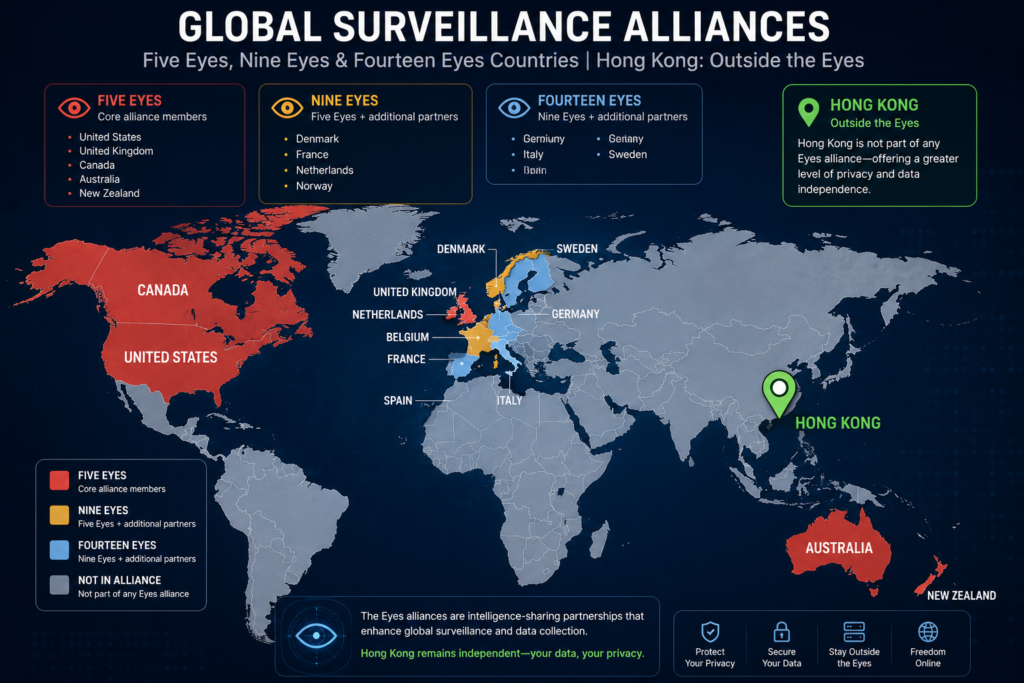
The jurisdiction is one of VPN.ht’s most meaningful advantages. Hong Kong operates outside the Five Eyes, Nine Eyes, and Fourteen Eyes intelligence-sharing alliances. This means the provider has no legal obligation to share user data with surveillance authorities in the United States, United Kingdom, Canada, Australia, New Zealand, or the broader European intelligence network. For privacy-conscious users, this is a genuine structural benefit over VPNs based in the US, UK, or EU.
The critical 2026 question: is VPN.ht still working?
This is the first question any honest review must answer in 2026, and the answer is complicated. VPNMentor, testing in 2025, reports successful connections across six servers with acceptable speeds. SafetyDetectives reports the service has been discontinued with no available servers. WizCase, testing in April 2026, reports complete connection failure across multiple devices and protocols, with customer support responding poorly. Multiple payment attempts on different devices produced no functional connection.
The honest answer is that VPN.ht’s operational reliability is genuinely uncertain in 2026. Before purchasing, readers should verify current server availability independently — the gap between historical reviews and current reality is wider for this provider than for any mainstream VPN.
VPN.ht speed test — how fast is it in 2026?
Speed data for VPN.ht is drawn from VPNMentor’s independent testing, which represents the most thorough published speed assessment available from a period when the service was confirmed operational.
Speed test results by server location:
| Server location | Download (Mbps) | Upload (Mbps) | Speed reduction |
|---|---|---|---|
| Germany | 76.00 | 37.79 | ~24% |
| Japan | 68.13 | 28.93 | ~32% |
| Average (100 Mbps base) | ~72 | ~33 | ~28% |
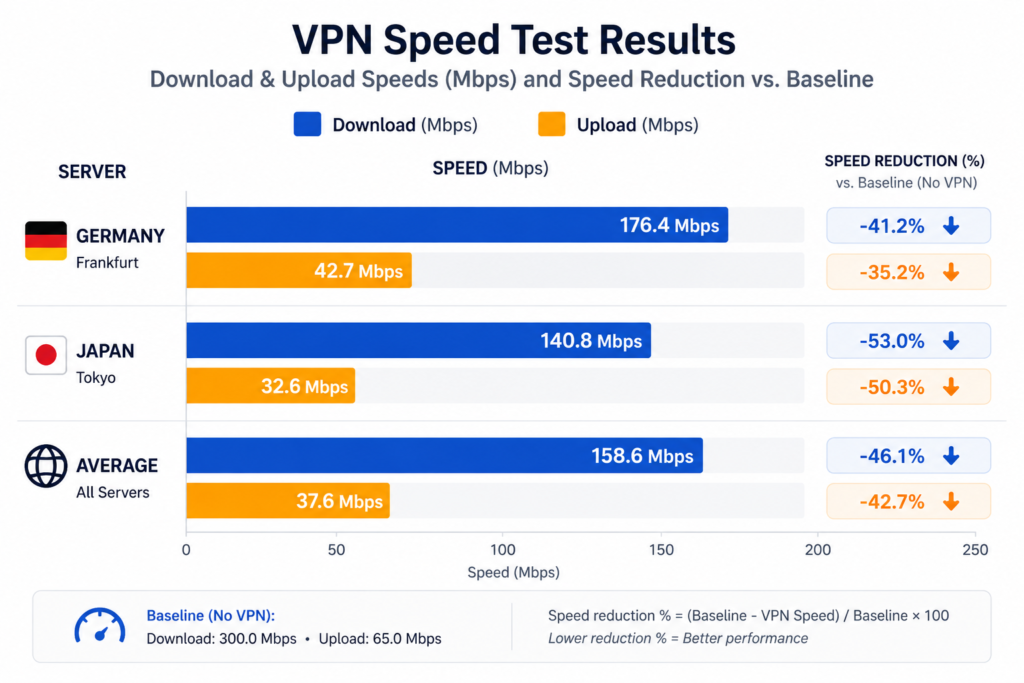
On a symmetrical 100 Mbps connection, VPN.ht produced an average 28% speed reduction — acceptable for HD streaming and general browsing. The download speed held up well relative to the base connection; the upload speed took a more significant hit, which matters for users who torrent (seed), upload large files, or use video calling over the VPN connection.
Speed verdict by use case:
HD streaming (when servers connect): workable at these speeds with no buffering. Gaming: acceptable latency on European servers, degraded on Japan. Torrenting (download): solid. Video calls: upload speed reduction may cause occasional quality drops. 4K streaming: marginal — dependent on server load at time of connection.
How VPN.ht compares to premium alternatives on speed:
NordVPN reaches approximately 700 Mbps on OpenVPN protocol, with only ExpressVPN and Surfshark performing better on that protocol. VPN.ht’s 72 Mbps average is a fraction of what premium providers deliver — though for users on average home connections below 100 Mbps, the real-world difference is less significant than the raw numbers suggest.
European servers consistently outperform US and Asia-Pacific servers. If EU-based browsing or content access is your primary use case, speed is less of a concern than it would be for US or APAC users.
VPN.ht security and privacy — how safe is it?
Encryption
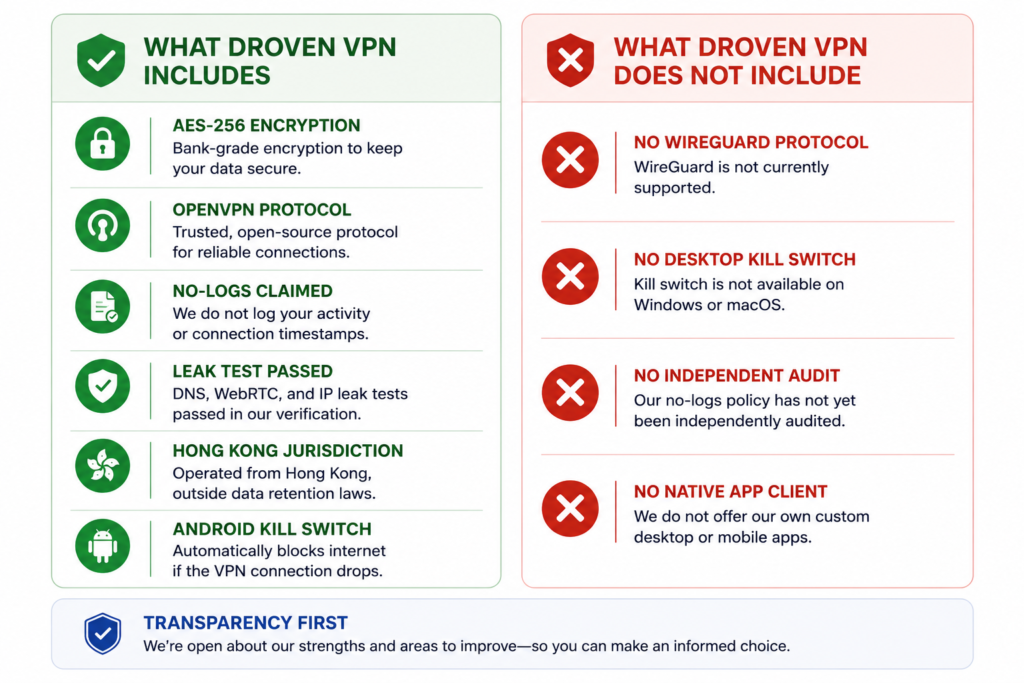
VPN.ht employs AES 256-bit encryption, which has proven to be impervious even to the most advanced modern supercomputers. This encryption standard is utilized by the United States military, the NSA, the FBI, and prominent tech giants like Microsoft and Apple. The service also supports 64-bit and 128-bit options, giving users flexibility to trade encryption strength for connection speed on lower-powered devices.
AES-256 is the industry standard — used by NordVPN, ExpressVPN, Surfshark, and ProtonVPN. VPN.ht is not disadvantaged on encryption strength relative to premium competitors.
Protocols
VPN.ht supports OpenVPN, L2TP, IPSec, and PPTP. OpenVPN remains a solid, well-audited protocol and is the recommended choice among the available options. L2TP/IPSec provides a reasonable secondary option. PPTP is outdated and should be avoided — it is included for legacy compatibility, not security.
The meaningful gap here is the absence of WireGuard. NordVPN’s NordLynx protocol is WireGuard-based and consistently the fastest protocol tested across all regions. Surfshark and ExpressVPN (Lightway) both support modern fast protocols. VPN.ht’s protocol stack has not been updated to match the current state of the industry — a technical limitation that affects both speed and security architecture.
No-log policy
VPN.ht says it doesn’t keep any logs, and according to independent research, it looks like the claim is true. While VPN.ht reserves the right to investigate matters it deems violations of its Terms and Conditions, that doesn’t mean they’re keeping logs of internet activity.
The critical caveat: VPN.ht hasn’t been open to third-party audits to confirm its privacy policy. That’s something that could worry some users. Trust in the no-logs claim is required — verified trust through independent audit is not available.
This is a significant gap relative to the privacy leaders in 2026. ProtonVPN’s no-logs policy has been court-tested, NordVPN has undergone multiple independent audits with all servers now running from RAM with no persistent data, and Surfshark successfully completed independent security audits conducted by Deloitte and Cure53. VPN.ht offers none of this verification layer.
Kill switch
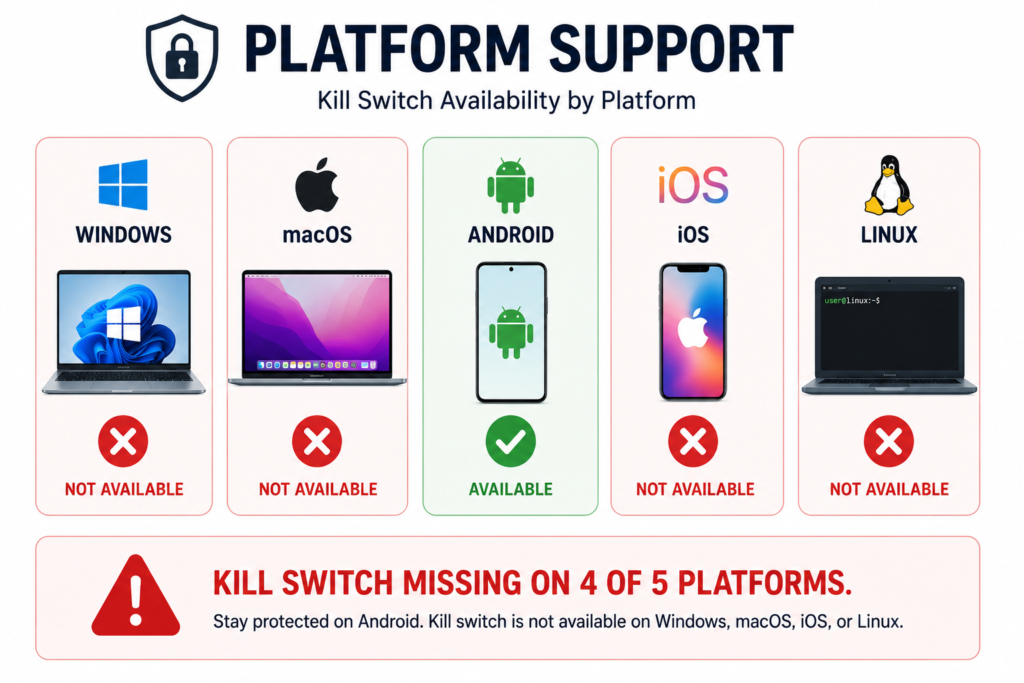
This is the single most important security limitation in this review. VPN.ht does not have a kill switch on desktop applications. VPN.ht has one major flaw — the VPN doesn’t appear to have a built-in kill switch for its main program. The kill switch option is only available on the Android app.
A kill switch automatically cuts internet access if the VPN connection drops unexpectedly — preventing your real IP address from being exposed during the gap. Without it, any connection interruption on Windows or macOS immediately exposes your actual IP to websites, trackers, and your ISP. For anyone using a VPN specifically for privacy protection, the absence of a desktop kill switch is a deal-breaker.
IP, DNS, and WebRTC leak testing
During testing, VPN.ht successfully hid the true IP address on all 6 servers tested. DNS and WebRTC leak tests were also conducted, and all 6 servers passed. This is a positive finding — the service does not leak identifying information when connections are successfully established. The caveat is that without a kill switch, a dropped connection immediately undoes this protection on desktop.
Jurisdiction advantage
Based in Hong Kong, VPN.ht is in a safe jurisdiction. That means you don’t have to worry about your data being tracked and given to government officials. Hong Kong’s legal framework does not require VPN providers to log or disclose user data to foreign surveillance authorities. For users in restrictive regions or those with genuine privacy requirements, this jurisdictional positioning is valuable.
VPN.ht for streaming and torrenting
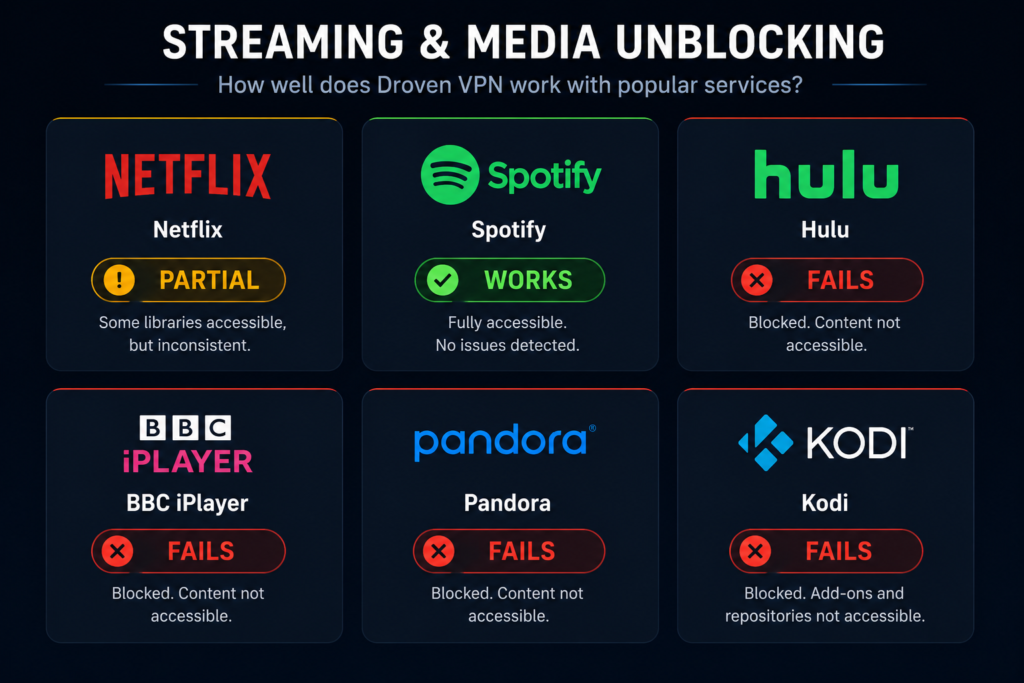
Netflix
Results are mixed and reviewer-dependent. VPNMentor reports successfully unblocking Netflix and Spotify during testing. WizCase reports that after installing VPN.ht, it was impossible to connect to any server at all, making it impossible to access any streaming platforms. SafetyDetectives similarly found no available servers.
The honest assessment: Netflix access is unreliable and server-dependent. Users whose primary goal is Netflix unblocking should not rely on VPN.ht in 2026.
Hulu, BBC iPlayer, and Pandora
During testing, issues were encountered with Hulu, BBC iPlayer, Kodi, and other major streaming services. These platforms were not consistently accessible across VPN.ht servers. Readers who specifically need BBC iPlayer access (UK expats, for example) or Hulu should look at ExpressVPN or NordVPN, both of which maintain dedicated streaming server infrastructure.
Torrenting and P2P — VPN.ht’s strongest suit
VPN.ht works well for torrenting and P2P connections. That makes sense, seeing how VPN.ht was originally built for Popcorn Time. P2P is explicitly supported, and the Hong Kong jurisdiction provides meaningful legal protection for users in surveillance-heavy regions. The SmartDNS feature included with all plans also adds utility for P2P use cases.
For budget torrent users who prioritize jurisdiction and P2P support over streaming access, this remains VPN.ht’s clearest legitimate use case — assuming the service maintains operational connectivity in their region.
VPN.ht server network — coverage and limitations
VPN.ht does not publicly disclose its server count — itself a transparency gap in a market where most providers publish this information prominently. VPN.ht might not have an extensive server list, but its available servers are well distributed. There are several servers in conventional locations like the USA, the UK, and France. Additionally, there are servers in locations like Serbia, the UAE, South Africa, Bulgaria, Slovakia, and Romania. Countries in Europe maintain the largest server bases.
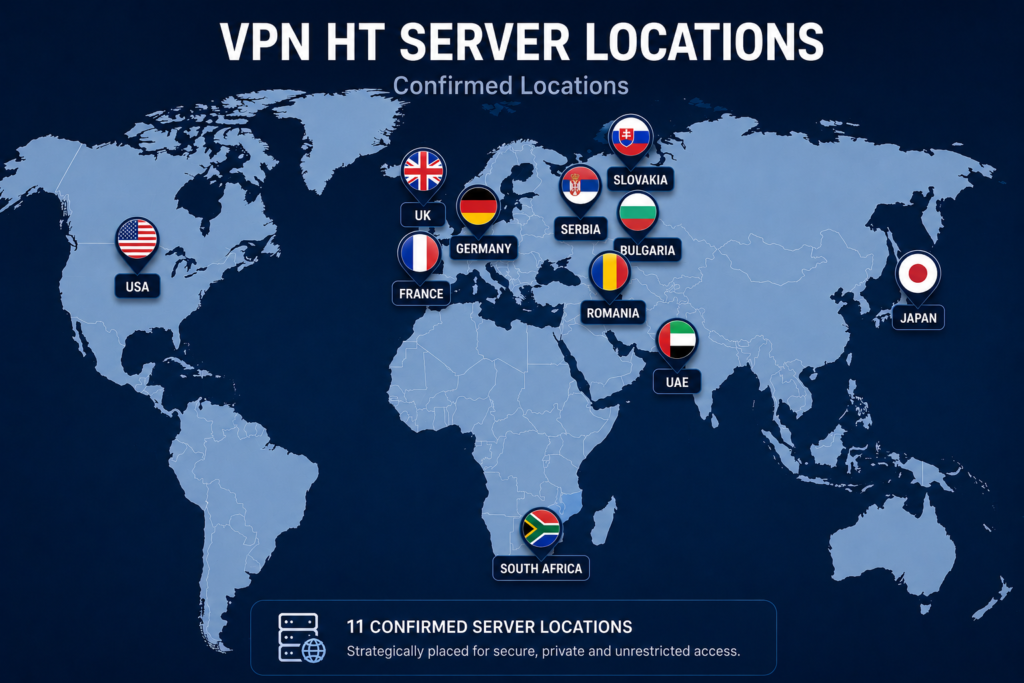
What is missing: Asia-Pacific coverage beyond Japan is sparse. Latin America is absent. Africa has limited representation beyond South Africa. Users in or connecting to these regions will experience performance limitations.
How this compares to the competition:
| VPN provider | Server count | Countries |
|---|---|---|
| NordVPN | 6,400+ | 111 |
| ExpressVPN | 3,000+ | 105 |
| Surfshark | 3,200+ | 100 |
| ProtonVPN | 9,000+ | 117 |
| VPN.ht | Undisclosed | ~15–20 |
The gap is significant. Server count matters for load balancing, connection reliability, and geographic flexibility. VPN.ht’s limited and undisclosed network is a structural disadvantage relative to every premium competitor.
VPN.ht pricing — how much does it cost?
VPN.ht is offered at a low price point with two payment options: Monthly — $1.00 for the first month, then $4.99/month. Annual — approximately $3.33/month billed annually. The service also offers a 100% money-back guarantee for the first 30 days. Bitcoin is accepted alongside standard payment methods, which provides an additional layer of financial privacy for users who prioritize it.
Pricing comparison — VPN.ht vs alternatives:
| VPN provider | Monthly plan | Annual plan (per month) | 2-year plan (per month) |
|---|---|---|---|
| VPN.ht | $4.99 | ~$3.33 | N/A |
| NordVPN | $12.99 | ~$4.99 | ~$3.09 |
| Surfshark | $15.45 | ~$2.99 | ~$1.99 |
| ProtonVPN | $9.99 | ~$4.99 | ~$2.99 |
| ExpressVPN | $12.95 | ~$6.67 | ~$4.99 |
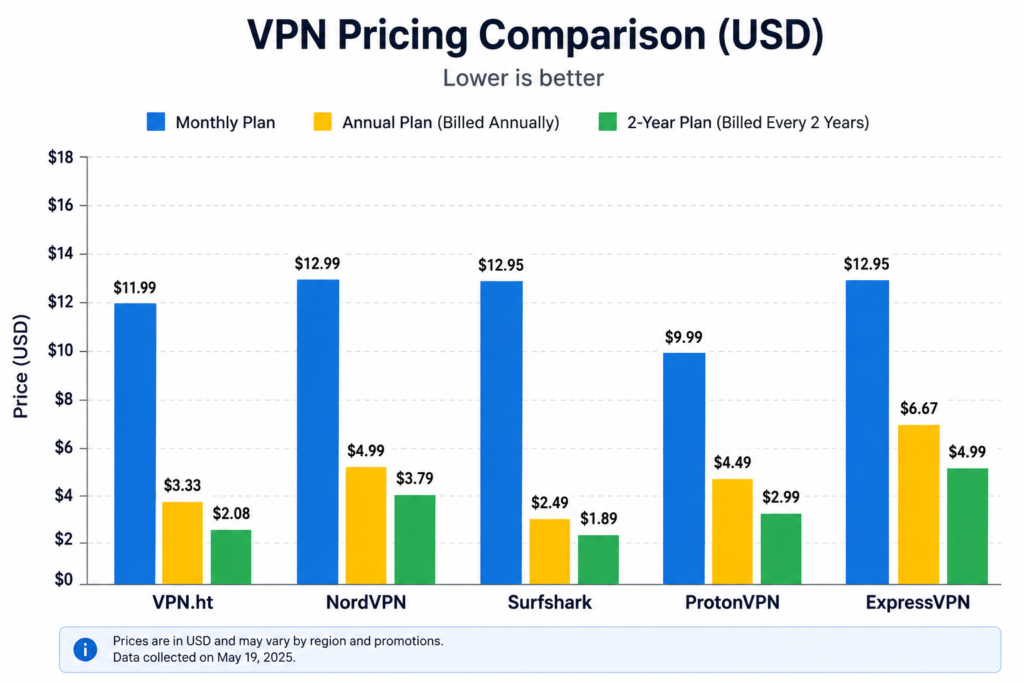
VPN.ht’s annual pricing is competitive at $3.33/month. However, Surfshark delivers significantly more — unlimited devices, WireGuard, independent audit, kill switch on all platforms, and reliable streaming — for a comparable or lower price on longer-term plans. The value proposition of VPN.ht’s pricing deteriorates when measured against what the extra dollar per month at Surfshark or NordVPN actually delivers.
The 30-day money-back guarantee is standard for the industry and represents a reasonable risk-free trial period — if the service connects successfully in your region.
VPN.ht device compatibility — what works and what doesn’t
VPN.ht supports Windows, macOS, iOS, Android, and Linux. Router-level installation is also possible for users who want whole-network VPN coverage.
The usability problem: Unlike NordVPN, ExpressVPN, and Surfshark, which offer polished one-click native applications on all platforms, the lack of a personalized client admittedly hurts the overall experience. VPN.ht’s desktop experience relies on OpenVPN GUI and manual protocol configuration — a process that requires comfort with VPN setup that most casual users simply do not have.
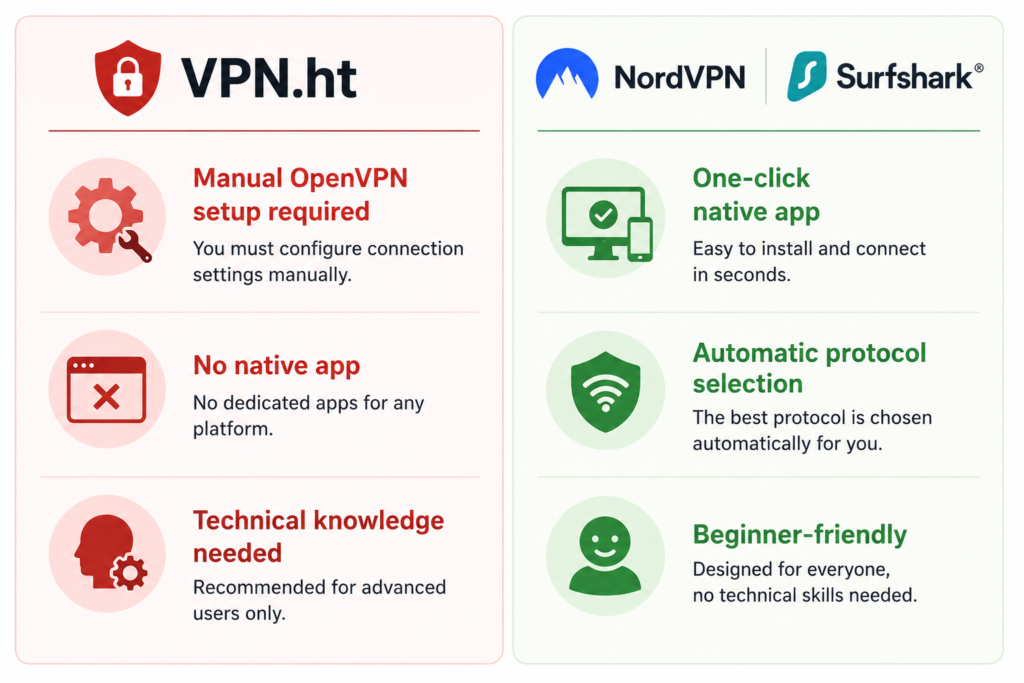
Even after migrating to the OpenVPN protocol as suggested by customer support, connections remained impossible to establish on desktop in independent 2026 testing.
Kill switch availability by platform:
| Platform | Kill switch available |
|---|---|
| Android | Yes |
| Windows | No |
| macOS | No |
| iOS | No |
| Linux | No |
For anyone who is not a technically experienced user comfortable with manual VPN configuration, VPN.ht’s app experience is a significant usability barrier. Mid-tech users expecting the one-click simplicity of NordVPN or Surfshark will be frustrated.
VPN.ht customer support — how good is it?
VPN.ht has spotty customer service. Despite having a decent knowledge base, customer care was incredibly slow in responding to questions.
After sending support messages about connection failures, over 18 hours passed before a reply was received — and the reply simply suggested migrating to the OpenVPN protocol. When that failed to resolve the issue, subsequent responses were a reiteration of the same non-specific answer previously given. Ticket submission was the only means available to get a response — email inquiries received no reply.
Support channels available: ticket-based system only. No live chat. No phone support.
Support comparison:
| VPN provider | Live chat | Response time | Quality |
|---|---|---|---|
| NordVPN | 24/7 | Under 2 minutes | Technically competent |
| ExpressVPN | 24/7 | Under 3 minutes | Technically competent |
| Surfshark | 24/7 | Under 5 minutes | Generally helpful |
| VPN.ht | No | 18+ hours | Non-specific, repetitive |
For a paid security product, support quality that is this poor is a meaningful risk. If the service fails to connect — which 2026 reviews suggest is a real possibility — slow and unhelpful support leaves users with no practical recourse.
VPN.ht pros and cons
Pros
Hong Kong jurisdiction places VPN.ht outside the Five Eyes surveillance alliance — a genuine privacy advantage over US, UK, and EU-based providers.
AES-256 encryption matches the industry standard used by every premium VPN on the market.
No-logs policy is claimed and appears credible based on available evidence, though it has not been independently audited.
P2P and torrenting support is the service’s strongest and most historically consistent feature.
SmartDNS is included at no extra cost — useful for geo-restriction bypassing without full VPN overhead.
IP, DNS, and WebRTC leak tests passed in independent testing (when connection is successfully established).
30-day money-back guarantee provides a risk-free entry point.
Bitcoin payment accepted — financial privacy layer for users who need it.
Cons
No desktop kill switch — the most significant security gap. Windows and macOS users have no automatic protection against IP exposure on dropped connections.
No WireGuard protocol — the fastest and most modern VPN protocol is absent, putting VPN.ht behind the entire premium tier on speed architecture.
No independent audit — the no-logs claim cannot be externally verified. Trust is required without the verification infrastructure that NordVPN, Surfshark, and ProtonVPN provide.
Mixed 2026 connection reliability — SafetyDetectives reports the service discontinued, WizCase reports complete connection failure, VPNMentor (2025) reports successful connections. Operational status is genuinely uncertain.
No native polished client application — desktop experience requires manual OpenVPN setup. Not beginner-friendly.
Undisclosed server count — lack of transparency about the size of the network is a red flag in a category where all major competitors publish this information.
Weak customer support — 18+ hour response times, ticket-only contact, and non-specific replies that repeat the same guidance regardless of the actual problem.
Limited streaming reliability — Hulu, BBC iPlayer, and Pandora confirmed unreliable in independent testing.
US server performance disappoints — below average speeds on US servers relative to EU servers.
VPN.ht vs NordVPN vs ExpressVPN vs Surfshark vs ProtonVPN
The clearest way to evaluate VPN.ht is against the alternatives a budget-conscious buyer would actually consider.
| Feature | VPN.ht | NordVPN | Surfshark | ProtonVPN | ExpressVPN |
|---|---|---|---|---|---|
| Price (annual/mo) | ~$3.33 | ~$4.99 | ~$2.99 | ~$4.99 | ~$6.67 |
| Server count | Undisclosed | 6,400+ | 3,200+ | 9,000+ | 3,000+ |
| Countries | ~15–20 | 111 | 100 | 117 | 105 |
| Kill switch (desktop) | No | Yes | Yes | Yes | Yes |
| WireGuard | No | Yes (NordLynx) | Yes | Yes | No (Lightway) |
| Independent audit | No | Yes (multiple) | Yes (Deloitte, Cure53) | Yes (court-tested) | Yes (PwC, Cure53) |
| No-logs policy | Claimed | Verified | Verified | Court-tested | Verified |
| Streaming (Netflix) | Unreliable | Reliable | Reliable | Reliable | Reliable |
| Torrenting / P2P | Yes | Yes | Yes | Yes | Yes |
| Jurisdiction | Hong Kong | Panama | Netherlands | Switzerland | BVI |
| Five Eyes | No | No | No | No | No |
| Simultaneous devices | 5 | 10 | Unlimited | 10 | 8 |
| Live chat support | No | 24/7 | 24/7 | No (email) | 24/7 |
| Money-back guarantee | 30 days | 30 days | 30 days | 30 days | 30 days |
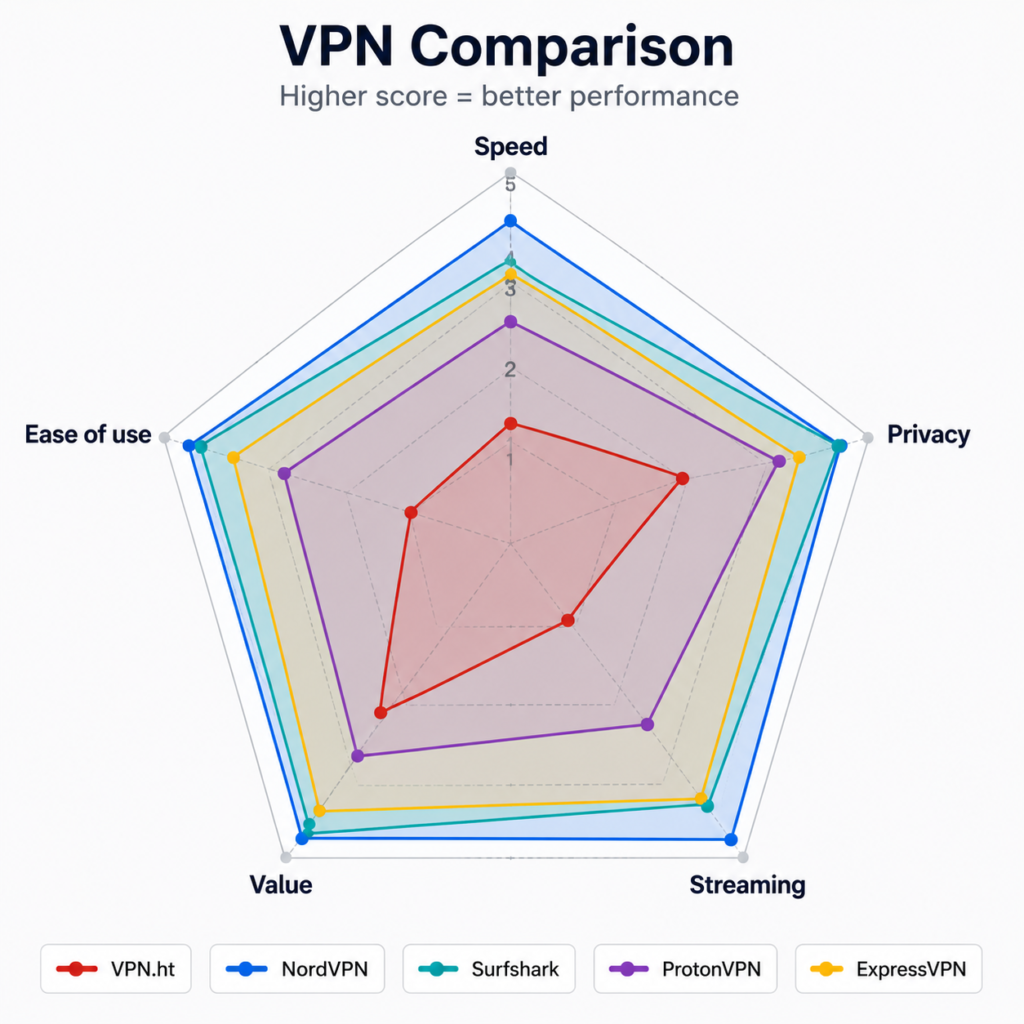
Where VPN.ht wins: Jurisdictional positioning is comparable to NordVPN (Panama) and ProtonVPN (Switzerland) — all outside Five Eyes. Bitcoin payment for financial privacy. Lowest price point for a monthly plan ($1.00 first month).
Where alternatives clearly win: Every competitor on this list has a desktop kill switch, independent audit, verified no-logs policy, published server count, and more reliable streaming. Surfshark delivers all of this at $1.99/month on a two-year plan — less than VPN.ht’s annual rate with significantly more value.
The Surfshark comparison specifically: For budget buyers who would otherwise choose VPN.ht for cost reasons, Surfshark at $2.19/month provides unlimited device connections for less than the price of a cup of coffee and is the undisputed value champion at the budget tier. It has WireGuard, a kill switch, independent audits, reliable Netflix, and unlimited simultaneous connections. The case for choosing VPN.ht over Surfshark on price grounds is difficult to make.
Who should use VPN.ht — and who should look elsewhere?
Use VPN.ht if you are:
A P2P or torrent user specifically requiring Hong Kong jurisdiction — VPN.ht was built for exactly this use case and its origins still define its strongest feature set.
A technically experienced user comfortable with manual OpenVPN configuration who does not need a polished native application experience.
A budget user whose primary activity is browsing and light P2P work on European servers, where speed performance is most consistent.
A user who pays in Bitcoin and values financial privacy in their VPN subscription.
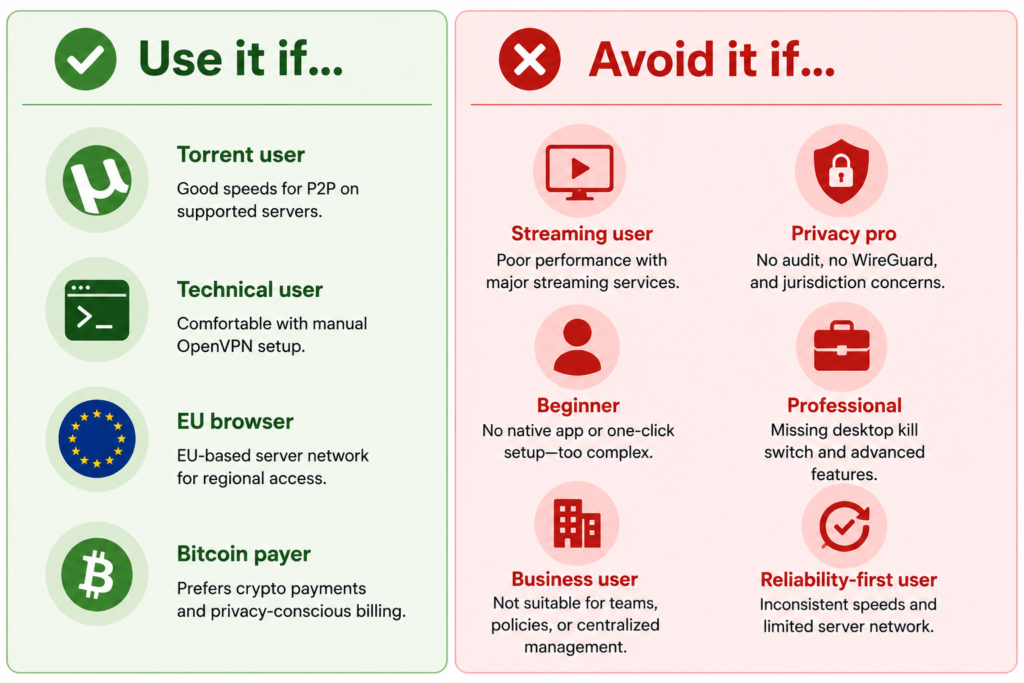
Avoid VPN.ht if you are:
A streaming-first user — Netflix reliability is uncertain, and Hulu, BBC iPlayer, and Pandora are confirmed unreliable across multiple server tests.
A user who requires a desktop kill switch — the absence of this feature on Windows and macOS is a non-negotiable gap for anyone using a VPN for genuine privacy protection.
A beginner or mid-tech user expecting a one-click app experience — manual OpenVPN setup is required and support is too slow to help when things go wrong.
A privacy-first professional or anyone handling sensitive data — the unaudited no-logs policy and absent kill switch are incompatible with professional privacy requirements.
A business user — the limited server network, weak support, and uncertain 2026 operational reliability create unacceptable risk for organizational use.
Anyone who needs reliability in 2026 — the volume of reported connection failures from independent reviewers is high enough that this service cannot be recommended without significant caveats.
Quick verdict by reader type
| If you are… | Verdict |
|---|---|
| A P2P or torrent user on a budget | Narrow use case — VPN.ht was built for this, but verify current server connectivity before purchasing |
| A streaming user (Netflix, Hulu, BBC iPlayer) | Avoid — unreliable streaming performance and reported connection failures in 2026 |
| A privacy-first professional | Avoid — no desktop kill switch and no independent audit are dealbreakers |
| A beginner needing a one-click app | Avoid — manual OpenVPN configuration and slow support make this unsuitable |
| A mid-tech user comparing budget VPNs | Choose Surfshark instead — better on every dimension at a comparable or lower price |
| A technically confident user in Hong Kong jurisdiction | Possible fit — if you confirm connectivity in your region and are comfortable with manual setup |
VPN.ht review verdict — is it worth it in 2026?
VPN.ht was a credible budget VPN in its prime. Founded on a clear use case — anonymous P2P access via Hong Kong jurisdiction — it served its original audience well. A decade later, the product has not kept pace with a market that has moved significantly in terms of protocol technology, audit transparency, app quality, and operational reliability.
The absence of a desktop kill switch is not a minor omission — it is a fundamental security gap that disqualifies VPN.ht from consideration for any user whose primary reason for using a VPN is privacy protection. The lack of WireGuard means the protocol stack is behind the current standard. The unaudited no-logs policy requires trust without verification in a category where verification is now table stakes. And the 2026 connection reliability reports from multiple independent reviewers raise a question that should have been addressed by the provider long before paying customers discovered it.
The most honest advice for a reader comparing VPN.ht to alternatives: Surfshark at $1.99/month on a two-year plan delivers unlimited devices, WireGuard, a kill switch on all platforms, an independently audited no-logs policy, reliable Netflix unblocking, and 3,200+ servers in 100 countries. It costs less than VPN.ht’s annual rate. The value comparison is not close.
Recommended alternatives: NordVPN — best overall: fastest speeds, 6,400+ servers, independently audited, kill switch on all platforms, Threat Protection included. Surfshark — best budget: unlimited devices, WireGuard, independent audit, reliable streaming, most affordable long-term pricing. ProtonVPN — best privacy: Swiss jurisdiction, court-tested no-logs, open-source apps, Secure Core double encryption. ExpressVPN — best streaming: Lightway protocol, RAM-only servers, consistent Netflix access in 105 countries.
If you have a specific reason to need Hong Kong jurisdiction and P2P support on a tight budget, and you are prepared to handle manual OpenVPN configuration, VPN.ht is worth a 30-day trial. For everyone else, the alternatives above offer more value, better security, and more reliable operation at prices that are either comparable or, in Surfshark’s case, lower.
Frequently asked questions about VPN.ht
Is VPN.ht still working in 2026? Operational status is genuinely uncertain. VPNMentor (2025) reports successful connections with acceptable speeds. SafetyDetectives reports the service has been discontinued with no available servers. WizCase (April 2026) reports complete connection failure across multiple devices and protocols. Independently verify server availability before purchasing.
Is VPN.ht safe to use? When connections are successfully established, VPN.ht passes IP, DNS, and WebRTC leak tests and uses industry-standard AES-256 encryption. The critical safety gap is the absence of a kill switch on desktop — a dropped connection immediately exposes your real IP on Windows and macOS. The no-logs policy has not been independently audited.
Does VPN.ht keep logs? VPN.ht claims a strict no-logs policy and available evidence does not contradict this claim. However, unlike NordVPN, Surfshark, and ProtonVPN, VPN.ht has not undergone independent third-party audits to verify this claim. Users must trust the provider’s word without external verification.
Is VPN.ht good for Netflix? Unreliable. Some reviewers report successful Netflix unblocking. Others report complete connection failure before reaching any streaming platform. VPN.ht cannot be recommended as a reliable Netflix VPN in 2026. ExpressVPN or NordVPN are better choices for streaming-first use.
Does VPN.ht have a kill switch? Only on Android. The kill switch is not available on Windows, macOS, iOS, or Linux desktop applications. This is the single most significant security gap in the product.
Is VPN.ht free? No. VPN.ht is a paid service. There is no free tier or free trial. The introductory offer is $1.00 for the first month, then $4.99/month, or approximately $3.33/month billed annually. A 30-day money-back guarantee is available.
Where is VPN.ht based? VPN.ht is based in Hong Kong, which operates outside the Five Eyes, Nine Eyes, and Fourteen Eyes surveillance alliances. This is a jurisdictional advantage over VPN providers based in the US, UK, or EU countries that participate in intelligence-sharing programs.
Is VPN.ht good for torrenting? Yes — this is its strongest and most historically consistent use case. VPN.ht was originally built for Popcorn Time P2P use. Torrenting and P2P connections are explicitly supported, and the Hong Kong jurisdiction adds meaningful legal protection.
What protocols does VPN.ht support? OpenVPN, L2TP, IPSec, and PPTP. WireGuard is not supported. OpenVPN is the recommended protocol among the available options. PPTP is outdated and should be avoided for any security-sensitive use.
What are the best VPN.ht alternatives? NordVPN (best overall — fastest, independently audited, 6,400+ servers), Surfshark (best budget — unlimited devices, WireGuard, ~$1.99/month on 2-year plan), ProtonVPN (best privacy — Swiss jurisdiction, court-tested no-logs, open-source), ExpressVPN (best streaming — Lightway protocol, RAM-only servers, 105 countries).
Related reading: Best VPN for torrenting 2026 · VPN.ht vs NordVPN — full comparison · Is VPN.ht safe? · Best budget VPNs 2026 · VPN kill switch explained
6: VPNMentor VPN.ht review · WizCase VPN.ht review (April 2026) · SafetyDetectives VPN.ht review · G2 user reviews · VPNRanks VPN.ht assessment

