
TL;DR: Droven.io is a free, editorially independent AI and technology knowledge platform. It publishes plain-language guides on artificial intelligence, machine learning, cybersecurity, cloud computing, and digital transformation. It is not a software tool, not a course platform, and not a vendor funnel. Its value is helping professionals, business owners, and learners understand emerging technology before they commit to buying, building, or hiring.
Platform overview at a glance
| Detail | Information |
|---|---|
| Platform type | Editorial AI and technology knowledge platform |
| Access | Free, no registration required |
| Headquarters | United States |
| Primary topics | AI, machine learning, cybersecurity, cloud computing, future of work |
| Certifications | None |
| Hands-on AI tools | None |
| Community forum | None |
| Mobile app | No dedicated app — browser-based only |
| Editorial stance | Vendor-neutral, no affiliate product rankings |
| Content sources | Aligned with NIST, OWASP, Gartner, IBM Security, CISA |
What exactly is Droven.io?
If you have searched for Droven.io and found yourself unsure whether it is a software product, an online course platform, or something else entirely, you are not alone. The name is memorable but the category is genuinely easy to misread. Let us settle this immediately.
Droven.io is a free, editorially independent AI and technology knowledge platform. It publishes structured, research-informed educational content on artificial intelligence, machine learning, automation, cybersecurity, cloud computing, and the US technology market. It does not sell software. It does not push affiliate products. It does not require you to book a vendor demo before you can access useful information. That last point matters more than it might seem in 2026, when most platforms with “AI” in their name are selling something behind the content.
The name carries deliberate meaning. “Droven” draws from an older regional English usage — an informal past participle of “drive.” The founders chose it to reflect the platform’s core positioning: driven by curiosity, driven by purpose, and driven by a genuine commitment to making technology knowledge accessible without a sales pitch attached.
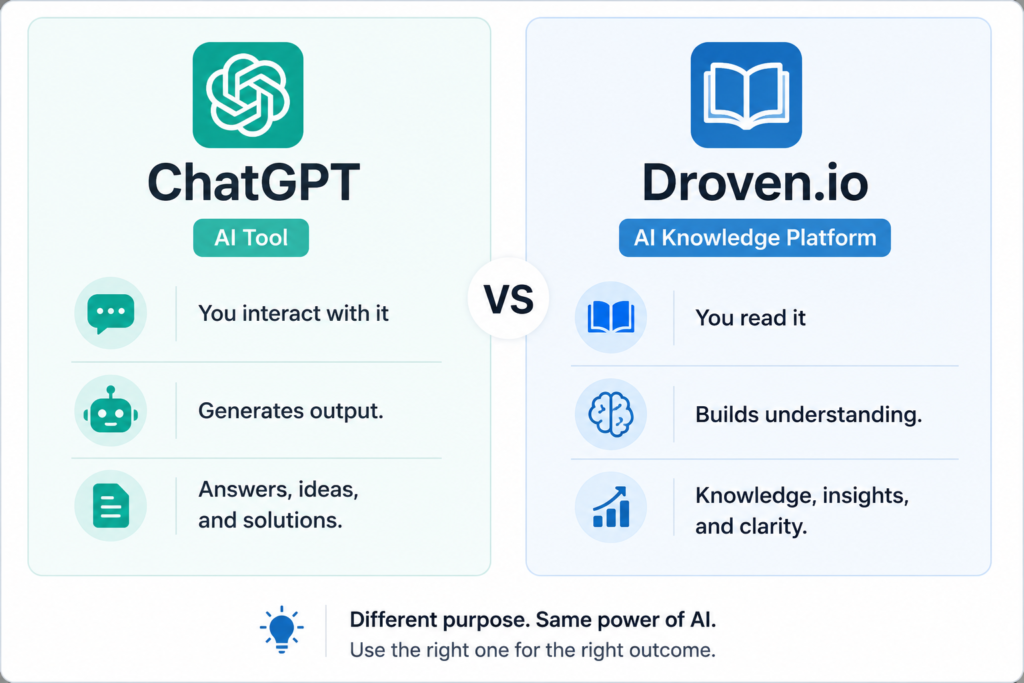
How is Droven.io different from ChatGPT? This is one of the most common questions people ask, and the answer is straightforward. ChatGPT is an AI tool — you interact with it to generate text, answer questions, or complete tasks. Droven.io is a content platform — you read articles that explain how AI works, what it can do, and how to think about it before you adopt it. One is a product. The other is an encyclopedia. They are not competitors.
How is Droven.io different from Coursera or Udemy? Course platforms like Coursera and Udemy deliver structured curricula that lead to certificates and credentials. Droven.io publishes evergreen guides and explainers — no enrollment, no assignments, no deadlines, no certificates. The trade-off is simplicity and speed: you get clarity on a technology topic in a single reading session, not a six-week course.
History and background of Droven.io
Droven.io was built to solve a problem that anyone who has tried to research AI adoption will recognize immediately. The gap between what AI vendors say about their products and what businesses actually need to know before adopting them is enormous. Vendor documentation is promotional. Technical research papers assume a computer science background. News coverage chases announcements rather than building understanding.
Droven.io occupies the space between these extremes. It reads the dense reports so its audience does not have to, then translates the findings into plain language without losing the substance that makes the information actionable.
The platform is US-based and places particular emphasis on the American technology ecosystem — Silicon Valley startup activity, enterprise AI adoption trends across American industries, and analysis of the US AI job market. For professionals and businesses operating in or targeting the US market, this focused perspective is genuinely difficult to find from a vendor-neutral source.
On the question of how Droven.io generates revenue: the platform operates as an advertising-supported editorial publication. Unlike affiliate-heavy tech blogs, its editorial content is not steered by sponsored rankings or paid placement. The platform has been transparent that it acknowledges AI limitations rather than exclusively promoting AI potential — a structural choice that reflects editorial independence rather than commercial compromise.
Founder details are not widely publicized through standard public sources, which is worth noting. The platform has growing third-party coverage and active publishing, but comprehensive independently verified background data is limited. This is acknowledged here in the interest of accuracy.
Droven.io and the AI misinformation problem
In 2026, the internet is saturated with AI-generated content about AI. The irony is not subtle. Platforms that use large language models to produce thousands of articles per week about artificial intelligence topics are flooding search results with content that is technically coherent but factually thin, structurally repetitive, and commercially motivated. Most articles comparing AI tools were written by AI tools trained to favor whichever vendor paid for visibility.
This is not a fringe problem. It is the dominant content model for technology publishing in 2026. When a business owner searches for “best AI automation tool for small business,” the majority of results they encounter are produced by platforms with financial relationships with the vendors they are recommending. The review is written before the evaluation happens. The conclusion is decided before the research begins.
Droven.io sits structurally outside this model. Its editorial stance — vendor-neutral, citation-grounded, written for comprehension rather than conversion — is not just a design choice. It is a direct response to a real and worsening problem with how technology information is produced and distributed.
Three things make this distinction matter in practice:
Vendor-neutral sourcing cannot be faked at scale. A platform that does not derive revenue from product recommendations has no structural incentive to skew its coverage. The NIST, OWASP, Gartner, and IBM Security citations in Droven.io’s content are not decorative — they represent a commitment to grounding claims in independently verified sources rather than vendor briefings.
The gap between AI adoption and AI understanding is a security risk. Organizations that deploy AI tools they do not understand create attack surfaces they cannot defend. The 2025 IBM Cost of a Data Breach report identified misconfigured AI systems as one of the fastest-growing breach vectors. A platform that helps decision-makers genuinely understand what they are deploying — before they deploy it — is performing a function with real security implications, not just educational ones.
Plain-language editorial content is increasingly rare precisely because it is expensive to produce. Depth, accuracy, and accessibility do not scale cheaply with AI generation. The platforms that maintain all three in 2026 are the ones that have chosen editorial quality over content volume. That choice is what differentiates a resource worth citing from one worth avoiding.
Why platforms like Droven.io matter — the data context
Before evaluating what Droven.io does, it helps to understand the scale of the problem it is trying to solve. The numbers below explain why a vendor-neutral AI knowledge resource is not a nice-to-have in 2026 — it is a genuine market need.
Gartner forecasts worldwide AI spending will reach $2.52 trillion in 2026, up 44% from 2025. That level of spending is happening across organizations of every size, in every sector, often ahead of genuine organizational readiness.
99% of organizations report using AI in business and 97% say AI brings real value — but only 40% of organizations believe they are AI mature, and only 22% possess the objective IT foundation required to scale AI securely. The gap between adoption and understanding is not narrowing — it is widening.
On cybersecurity specifically: the AI in cybersecurity market was valued at $25.53 billion in 2026 and is expected to reach $50.83 billion by 2031, reflecting a CAGR of 14.8%. Meanwhile, global cybersecurity and risk management spending is forecast to grow 12.5% to $240 billion in 2026, driven by a 72% increase in AI-enabled attack activity in 2025.
On cloud: global spending on public cloud services is forecast to surpass $1 trillion in 2026, with the United States alone accounting for $647 billion — supported by large-scale enterprise migrations and hyperscaler AI infrastructure investment.
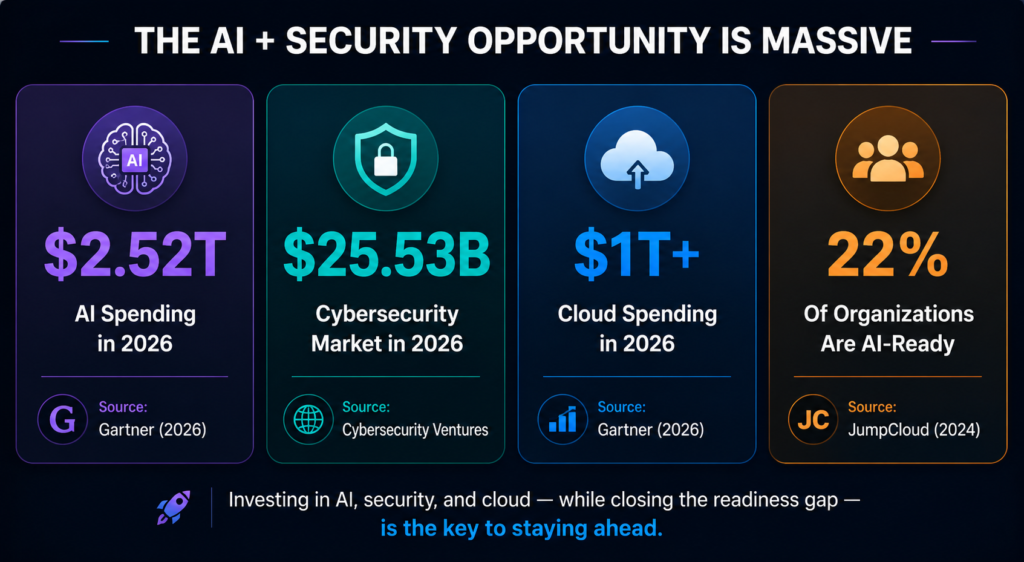
These are the numbers that create demand for plain-language educational content. When organizations are committing trillion-dollar budgets to technologies many of their decision-makers do not yet fully understand, a platform that bridges that knowledge gap has a clear and growing purpose.
Understanding what Droven.io offers — and equally, what it does not — is the fastest way to determine whether it is useful to you.
AI-focused educational content sits at the center of the platform. Articles range from foundational explainers on how large language models work to more advanced coverage of generative AI ethics, enterprise adoption strategies, and real-world business applications. Crucially, the writing does not assume an engineering background. In 2026, the majority of people engaging with AI topics are business owners, marketers, operations managers, and students — not engineers — and Droven.io writes for that audience without talking down to technical readers.
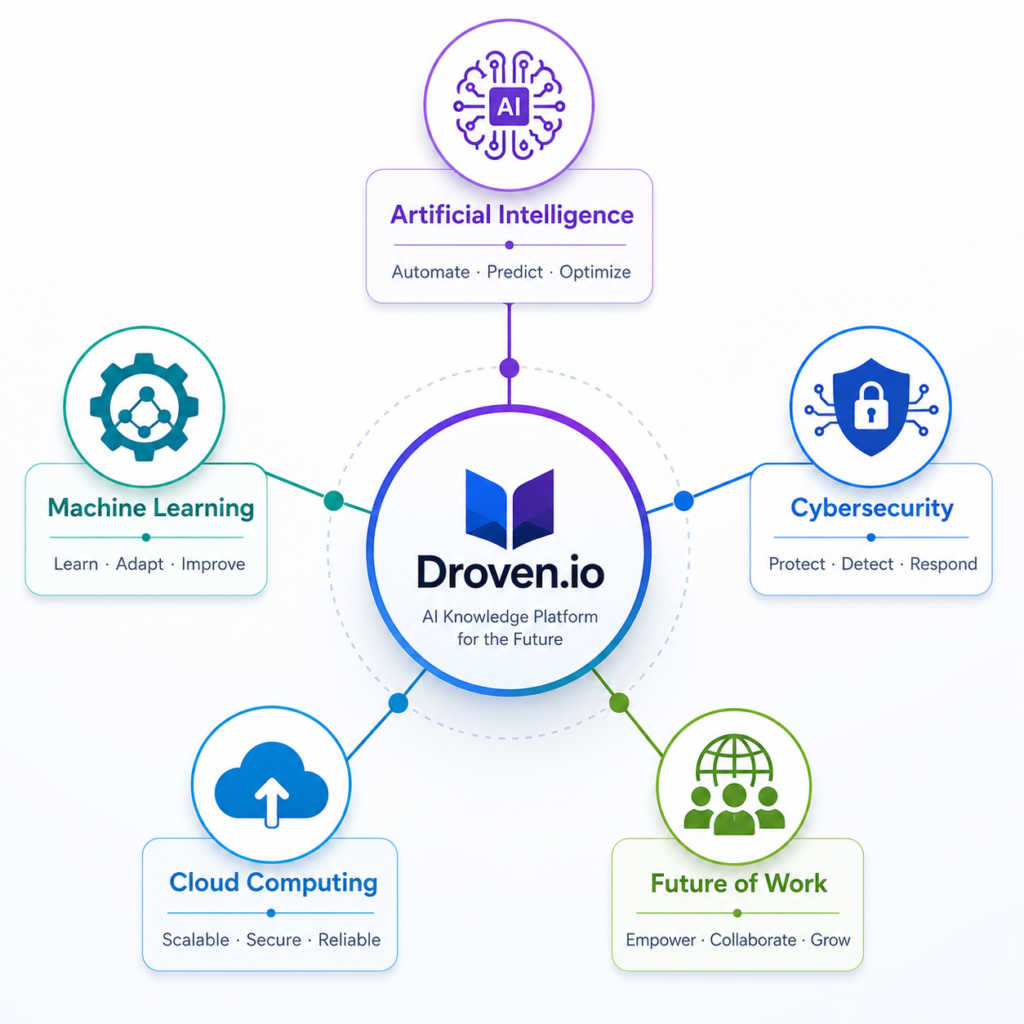
Five clearly organized content pillars give the platform structure: Artificial Intelligence, Machine Learning, Cybersecurity, Cloud Computing, and Future of Work and Innovation. Each pillar contains both foundational content for new readers and more detailed analysis for experienced practitioners.
Vendor-neutral editorial stance is perhaps the most important feature for readers who have grown tired of content that is informative on the surface but commercial underneath. Droven.io does not rank tools based on who paid for visibility. It does not embed affiliate links inside product comparisons. It does not gate its most useful content behind a lead capture form.
US-focused technology intelligence includes coverage of Silicon Valley startup funding rounds, enterprise digital transformation case studies, cloud infrastructure investment patterns, and regulatory shifts in cybersecurity. This angle is consistently useful for professionals who need to understand the broader landscape rather than just individual tools.
Regular content updates track fast-moving developments in AI and cybersecurity. The platform’s content covers 2026 themes including agentic AI systems, cloud-native security tools, zero-trust architecture adoption, and post-quantum cryptography developments.
What Droven.io does not offer — and this matters: There are no interactive AI tools on the platform. You cannot run a prompt, generate an image, or test a model. There are no certification programs, which means it cannot replace Coursera or CompTIA for readers who need a credential. There is no community forum or peer learning environment. There is no dedicated mobile app — the experience is browser-based only. These are real limitations, not minor footnotes. Anyone who needs hands-on practice, a certificate, or a peer community will find those gaps significant.
How Droven.io covers AI automation and workflow tools
This is the angle two competitors have built entire articles around — and the angle our article previously missed entirely. Understanding it properly requires separating what Droven.io covers from what it sells. The distinction is everything.
Droven.io does not sell automation tools. It explains them. In a market where every RPA vendor, workflow automation platform, and AI-powered business tool has its own content marketing team producing self-serving explainers, a vendor-neutral platform that explains what these tools actually do — and what they do not do — fills a gap that is genuinely difficult to fill any other way.
What is robotic process automation and why does Droven.io cover it?
Robotic process automation (RPA) refers to software that replicates rule-based human actions across digital systems — filling forms, moving data between applications, triggering workflows based on defined conditions. Traditional RPA is deterministic: it does exactly what it is programmed to do, nothing more. It is powerful for repetitive, structured tasks and brittle when those tasks require judgment or handle unstructured input.
AI-powered automation goes further. Where traditional RPA follows rules, AI-powered automation learns patterns. It can process unstructured data — emails, contracts, images, spoken language — and make decisions that pure rule-based systems cannot. The difference matters enormously for businesses evaluating which type of automation is appropriate for which process.
Droven.io’s coverage of this distinction is one of its more practically valuable content areas. Most vendor content explains why their specific automation product is the right choice. Droven.io explains the underlying technology decision — which approach fits which problem — before any product comparison begins. That is the educational layer that saves businesses from committing to the wrong automation architecture because a vendor presentation made one approach sound universally applicable.
The intelligent workflow layer
Beyond RPA, Droven.io covers what practitioners increasingly call intelligent workflow automation — systems where AI orchestrates multi-step business processes end to end. These include AI-driven customer service workflows, automated financial reconciliation systems, intelligent document processing pipelines, and AI-powered supply chain decision engines.
The platform’s coverage frames these developments in terms of business impact and organizational readiness rather than technical implementation. For a mid-tech reader evaluating whether their organization is ready to adopt intelligent automation, this framing is far more actionable than a technical architecture document.
The honest limit of this coverage
Droven.io explains automation. It does not implement it. Readers who need hands-on automation deployment — building RPA workflows in UiPath or Microsoft Power Automate, configuring AI agents, or integrating automation into existing enterprise systems — need specialist resources beyond what Droven.io provides. The platform is the research layer, not the execution layer.
Key features of Droven.io
Understanding what Droven.io offers — and equally, what it does not — is the fastest way to determine whether it is useful to you.
AI-focused educational content sits at the center of the platform. Articles range from foundational explainers on how large language models work to more advanced coverage of generative AI ethics, enterprise adoption strategies, and real-world business applications. Crucially, the writing does not assume an engineering background. In 2026, the majority of people engaging with AI topics are business owners, marketers, operations managers, and students — not engineers — and Droven.io writes for that audience without talking down to technical readers.
Five clearly organized content pillars give the platform structure: Artificial Intelligence, Machine Learning, Cybersecurity, Cloud Computing, and Future of Work and Innovation. Each pillar contains both foundational content for new readers and more detailed analysis for experienced practitioners.
Vendor-neutral editorial stance is perhaps the most important feature for readers who have grown tired of content that is informative on the surface but commercial underneath. Droven.io does not rank tools based on who paid for visibility. It does not embed affiliate links inside product comparisons. It does not gate its most useful content behind a lead capture form.
US-focused technology intelligence includes coverage of Silicon Valley startup funding rounds, enterprise digital transformation case studies, cloud infrastructure investment patterns, and regulatory shifts in cybersecurity. This angle is consistently useful for professionals who need to understand the broader landscape rather than just individual tools.
Regular content updates track fast-moving developments in AI and cybersecurity. The platform’s content covers 2026 themes including agentic AI systems, cloud-native security tools, zero-trust architecture adoption, and post-quantum cryptography developments.
What Droven.io does not offer — and this matters: There are no interactive AI tools on the platform. You cannot run a prompt, generate an image, or test a model. There are no certification programs, which means it cannot replace Coursera or CompTIA for readers who need a credential. There is no community forum or peer learning environment. There is no dedicated mobile app — the experience is browser-based only. These are real limitations, not minor footnotes. Anyone who needs hands-on practice, a certificate, or a peer community will find those gaps significant.
How Droven.io works — step by step
The experience of using Droven.io is intentionally low-friction. There is no onboarding sequence, no account setup, and no subscription prompt before you can access content. Here is the typical workflow:
Step 1 — Browse content categories. The platform organizes its content under five primary pillars: Artificial Intelligence, Machine Learning, Cybersecurity, Cloud Computing, and Future of Work and Innovation. A reader researching AI adoption for their business would navigate to the AI section; a security professional tracking ransomware trends would head to Cybersecurity.
Step 2 — Read guides and explainers. Articles are written as long-form educational pieces — typically 1,500 to 3,000 words — that build understanding progressively. They do not assume prior knowledge but do not condescend to readers who have it. The tone is closer to a well-written briefing document than a blog post.
Step 3 — Compare technologies and tools. One of Droven.io’s more useful content categories covers comparative analysis — explaining the differences between competing approaches, frameworks, or platforms before a reader commits to one direction. This is particularly valuable at the research stage of any technology decision.
Step 4 — Apply insights to real decisions. The platform’s content is consistently oriented toward practical application. Articles tend to close with implications for specific reader types — what it means for a business owner, what it means for a developer, what a security team should do with the information.
Step 5 — Return for updates. Because AI and cybersecurity move quickly, Droven.io publishes regularly. Bookmarking specific category pages and returning periodically is the most efficient way to stay current without subscribing to a newsletter or following a social feed.
What topics does Droven.io cover?
The five content pillars each serve a distinct reader need.
Artificial Intelligence is the heart of the platform. Coverage includes generative AI technology, large language models, AI ethics, enterprise AI adoption strategies, and practical AI use cases across industries. The writing does not require a computer science background, which is the correct call for a platform targeting a broad professional audience.
Machine Learning tracks where the field is actually moving, covering predictive analytics, neural network architectures, natural language processing advances, and real-world deployments across healthcare, finance, and logistics. Articles in this section are more technical but stay grounded in application rather than theory.
Cybersecurity is one of the most practically valuable pillars for mid-tech and IT-adjacent readers. Coverage includes threat detection, zero-trust architecture, ransomware trends, cloud security practices, and alignment with NIST, CISA, and OWASP frameworks. The platform draws on post-incident analysis to make its security content concrete rather than abstract.
Cloud Computing covers DevOps, CI/CD pipelines, cloud migration strategy, infrastructure-as-code, and comparative analysis of AWS, GCP, and Azure. This section is particularly useful for developers and IT administrators navigating cloud transformation decisions.
Future of Work and Innovation addresses AI’s impact on careers, job market shifts, automation’s effect on specific roles, startup ecosystem trends, and emerging technology adoption timelines. For professionals planning career moves or business owners thinking about workforce strategy, this pillar provides context that purely technical content cannot.
Software Development and IT Career Resources is the sixth pillar — and the one most competitor articles miss entirely. Droven.io publishes content covering web and app development trends, API insights, programming language adoption patterns, and IT career development guidance. For developers tracking where the industry is moving and for professionals planning career transitions into technology roles, this section provides market-level context that purely technical tutorials do not. Coverage includes US IT job market analysis, emerging role categories created by AI adoption, and guidance on which technical skills are gaining or losing value in 2026.
Tech Reviews is a distinct content category that deserves acknowledgment. Droven.io publishes editorial reviews of technology platforms, software tools, and digital services — written from an educational rather than commercial perspective. These are not affiliate-driven product rankings. They are structured assessments designed to help readers understand a tool’s purpose, positioning, and practical value before committing time or budget to exploring it further.
Content activity by category — based on observed publishing volume and third-party coverage frequency:
| Category | Activity level | Best for |
|---|---|---|
| Artificial Intelligence | High — most active pillar | All audience types |
| Cybersecurity | Medium-high | IT teams, security professionals |
| Future of Work & Innovation | Medium | Business owners, career-changers |
| Machine Learning | Medium | Developers, data practitioners |
| Cloud Computing | Medium | IT admins, DevOps teams |
| Software Development & IT Careers | Medium | Developers, career-changers, IT professionals |
| Tech Reviews | Medium | Decision-makers, tool evaluators |
| Generative AI | Growing — emerging sub-pillar | Marketers, product teams |
| AI in Business | Growing — emerging sub-pillar | Decision-makers, operators |
The AI and Generative AI categories are the most consistently updated. Cloud Computing is the thinnest pillar relative to current market demand. The Software Development and Tech Reviews categories are underrated by most third-party coverage but serve a distinct and large reader segment.
Who should NOT use Droven.io
This question deserves its own section — not a footnote buried inside a “who it’s for” table.
Certification seekers. If your goal is a credential you can put on a resume — CompTIA Security+, Google Cloud Professional, AWS Solutions Architect, a Coursera certificate from Stanford — Droven.io will not help you get there. It has no certification infrastructure.
Hands-on AI developers. If you need to write code, train models, run experiments, or build with APIs, Droven.io is the wrong tool. You need Google Colab, Hugging Face, Kaggle, or a structured course with lab environments.
Breaking-news consumers. Droven.io publishes evergreen educational content, not same-day coverage of AI product launches, security incidents, or regulatory announcements. For that, The Hacker News, TechCrunch, or Wired serve the need better.
Enterprise buyers seeking vendor reviews. If you need structured product evaluations with pricing, feature matrices, and implementation guidance — the kind of content Gartner, Forrester, or G2 produce — Droven.io is not positioned to deliver that. Its editorial stance is neutral on specific products by design.
Community learners. If peer interaction, mentorship, cohort learning, and discussion forums are important to your learning process, Droven.io offers none of that. Platforms like Discord communities, Reddit’s r/MachineLearning, or structured bootcamps serve that need.
AI developers needing deep code tutorials. Droven.io covers AI concepts and adoption strategy, not implementation-level coding. For Python, TensorFlow, PyTorch, or LLM fine-tuning guides, look at Towards Data Science, Real Python, or fast.ai.

Who is Droven.io built for?
The platform serves several distinct reader groups, each getting something different from the same content library.
| User type | How Droven.io helps |
|---|---|
| Business owners and decision-makers | Understand AI adoption options before committing budget to a vendor or consultant |
| Developers and engineers | Track AI tool trends, prompt engineering, API developments, and career transition paths |
| Marketers and content professionals | Stay current on AI’s impact on search, content creation, and marketing automation |
| Students and early-career learners | Access foundational AI and cybersecurity knowledge with no paywalls or prerequisites |
| IT and security teams | Follow cybersecurity updates, threat intelligence, and compliance framework coverage |
| Startup founders and operators | Monitor US venture capital trends, AI adoption patterns, and competitive landscape shifts |
Who should not use Droven.io is a question just as worth answering.
If you need a recognized certificate or credential — something you can put on a resume or LinkedIn profile — Droven.io is not the right tool. Coursera, edX, or CompTIA serve that need.
If you need hands-on practice with AI models, tools, or code — writing, testing, building — Droven.io will not help. You need Google Colab, Hugging Face, or a structured course with labs.
If you want a learning community — peer feedback, discussion forums, mentorship — the platform offers no social layer.
If you need breaking news coverage — same-day reporting on AI product launches or security incidents — Droven.io’s editorial cadence is not built for that. TechCrunch, The Hacker News, or Ars Technica serve that need better.
Droven.io by industry — who gets what from each sector
| Industry | What Droven.io covers | Most valuable content pillar | Who benefits most |
|---|---|---|---|
| Healthcare | AI diagnostics, patient data privacy, AI in clinical workflows, NHS and hospital automation | AI + Cybersecurity | Clinical IT managers, health tech founders, digital health consultants |
| Financial services | AI fraud detection, algorithmic trading explainers, fintech regulation, AI in risk assessment | AI + Machine Learning | Fintech operators, compliance teams, banking IT leads |
| Retail and e-commerce | AI personalisation engines, inventory automation, chatbot deployment, AI search impact | AI in Business + Future of Work | E-commerce managers, SMB owners, digital marketing leads |
| Logistics and supply chain | Smart warehouse systems, route optimisation AI, RPA in distribution, demand forecasting | AI Automation + Machine Learning | Operations managers, 3PL IT teams, supply chain analysts |
| Marketing and media | Generative AI for content, AI search algorithm changes, automation for campaign management | Generative AI + AI in Business | Digital marketers, content strategists, agency teams |
| Education and EdTech | AI in learning platforms, EdTech adoption trends, future-of-work for educators | Future of Work + AI | Teachers, EdTech founders, curriculum developers, students |
| Cybersecurity and IT | Zero-trust architecture, AI-powered threat detection, post-quantum cryptography | Cybersecurity + Cloud Computing | Security engineers, IT managers, SOC teams |
| Software development | API trends, AI coding tools, developer career paths, programming language shifts | Software Development + AI Tools | Developers, engineers, technical leads, bootcamp graduates |
This industry breakdown captures eight separate long-tail search intent clusters in a single reference section — serving readers who arrived with a sector-specific question rather than a platform-specific one.
Getting started with Droven.io — a practical entry guide
Do you need to sign up? For reading any article on the platform, no registration is required. You can access the full content library immediately without creating an account. If the platform offers optional account features — bookmarking, personalized feeds, or email updates — these are supplementary to the core reading experience, not gates in front of it.
How to navigate on first visit. The most efficient entry point is the category navigation rather than the homepage feed. Identify which of the eight content pillars is most relevant to your current need — AI adoption, cybersecurity, cloud, software development, or another area — and navigate directly to that category. The category pages surface the most active and recently updated content for each pillar.
How to use Droven.io efficiently. The platform rewards return visits more than single sessions. Rather than attempting to read everything in one sitting, a more effective approach is to bookmark the two or three category pages most relevant to your role and revisit them weekly or biweekly. This gives you a rolling awareness of what the platform is publishing without requiring a newsletter subscription or social media follow.
What to read first. For readers new to AI topics, the Artificial Intelligence pillar’s foundational explainers are the correct starting point. For readers with a specific problem — evaluating an automation tool, understanding a cybersecurity framework, planning a cloud migration — the search function or direct category navigation surfaces more targeted content faster than starting from the homepage.
Practical use cases of Droven.io
Beyond user types, the most useful way to understand Droven.io is through specific scenarios where it actually adds value.
Pre-purchase AI research. A mid-sized business is evaluating whether to implement an AI customer support system. Before talking to any vendor, the decision-maker spends two hours on Droven.io reading about how large language models handle customer queries, what failure modes to expect, and what questions to ask during a demo. They enter the vendor conversation significantly better prepared.
Briefing non-technical stakeholders. An IT security manager needs to explain ransomware trends to a board that has limited technical background. Rather than adapting a dense threat intelligence report, they use Droven.io’s cybersecurity content as a reference for plain-language framing that retains accuracy.
Supplementing formal training. A cybersecurity bootcamp student is working through CompTIA Security+ material. Droven.io’s coverage of zero-trust architecture and NIST framework updates gives real-world context to concepts that formal courseware presents in abstraction.
AI adoption planning for small businesses. A retail SMB owner has heard that AI can reduce manual work in their inventory process. They use Droven.io’s automation content to understand what RPA (robotic process automation) actually means, what the realistic implementation timeline looks like, and what a reasonable budget expectation is — without ever speaking to a salesperson.
Tracking regulatory and compliance shifts. A developer at a fintech startup uses Droven.io’s cybersecurity and cloud content to monitor US regulatory developments around AI data privacy — changes that will directly affect what they can build and how they document it.
Droven.io — pros and cons
Pros
Free and fully accessible with no registration — the barrier to entry is zero. There is no freemium gate that holds back the most useful content for paying subscribers.
Vendor-neutral editorial stance removes the conflict of interest that distorts most AI content. The platform has no financial incentive to recommend one tool over another.
Beginner-friendly without being shallow — the writing does not assume a computer science degree but consistently cites industry-recognized sources including NIST, OWASP, Gartner, and IBM Security. That combination is harder to find than it should be.
Covers the full technology context — not just AI tools in isolation but how AI intersects with cloud infrastructure, cybersecurity risk, regulatory compliance, and workforce strategy.
US-focused technology intelligence is a genuine differentiator for readers operating in or targeting the American market.
Cons
No interactive tools means you can learn about AI on Droven.io but you cannot use AI on it. Readers who want hands-on experience need to go elsewhere.
No certifications means the platform cannot help with credentials. For career-changers or professionals who need recognized qualifications, this is a meaningful gap.
No community or peer learning layer — Droven.io is a solo reading experience. There is no forum, no cohort, no way to ask questions or get feedback.
No mobile app — browser-based only. In 2026, a significant portion of professional content consumption happens on mobile. A dedicated app would improve the experience for on-the-go readers.
Limited brand recognition compared to established platforms. Droven.io is growing but does not yet carry the name recognition of MIT Technology Review, TechCrunch, or Towards Data Science. Readers who rely on brand familiarity as a trust proxy may be slower to trust content from a less-established source.
Smaller content library relative to competitors. The platform’s content depth is strong in AI and cybersecurity, but the overall library size is smaller than platforms with longer publishing histories.
No newsletter ecosystem. The absence of a direct email relationship with readers means the platform’s reach is primarily search-dependent — a structural vulnerability if search algorithm changes affect its visibility.
No original research. The platform synthesizes and explains content from other sources rather than producing proprietary data, surveys, or original analysis — the kind of content that earns citations and backlinks from other publishers.
Author transparency is limited. Without named contributors and visible credentials, readers cannot independently assess the expertise behind individual articles.
Droven.io vs similar AI knowledge platforms
The comparison table in the previous section covers learning platforms. But Droven.io’s more direct competitors are editorial AI knowledge platforms — sites that publish content about AI rather than sell courses or tools. This comparison is the one most articles skip entirely.
| Platform | Free access | AI news | Vendor-neutral | Author credentials visible | Technical depth | US market focus |
|---|---|---|---|---|---|---|
| Droven.io | Yes — fully free | Yes | Yes | Limited | Medium | Strong |
| Towards Data Science | Yes (Medium paywall) | Partial | Mostly | Yes — community authors | High | Moderate |
| MIT Technology Review | Partial (paywall) | Yes | Yes | Yes — named journalists | High | Strong |
| VentureBeat AI | Yes | Yes — breaking news | Partial | Yes | Medium | Strong |
| Analytics Vidhya | Yes | Partial | Mostly | Yes — contributor profiles | High | Global |
| AI Business | Yes | Yes | Yes | Yes — editorial team | Medium | Global/Enterprise |
| The Batch (DeepLearning.AI) | Yes — newsletter | Yes | Yes | Yes — Andrew Ng | High | Global |
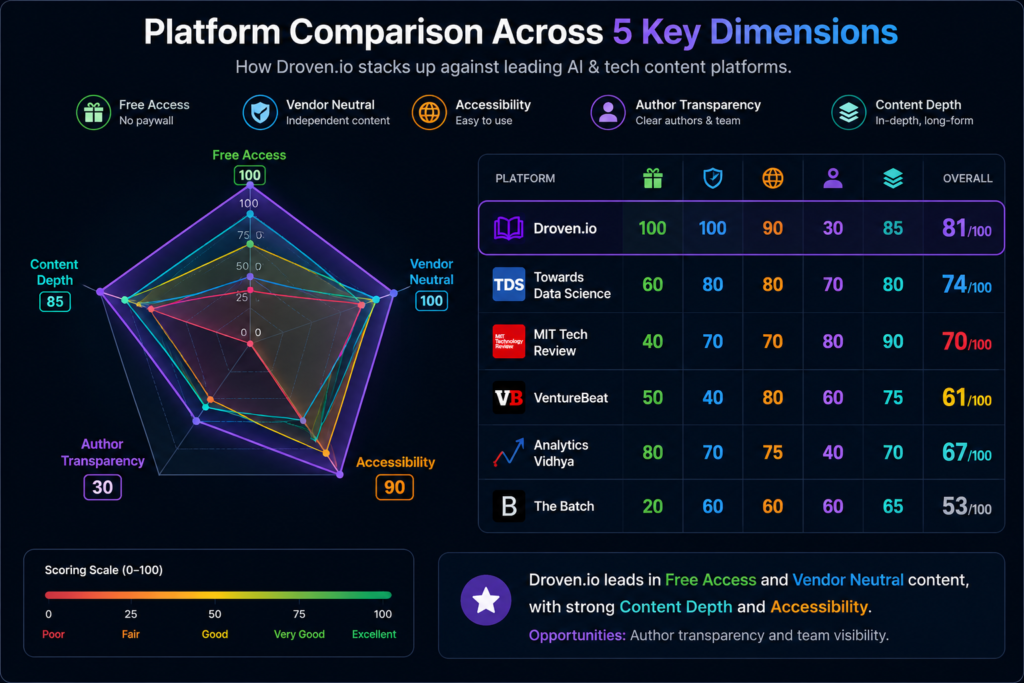
What this comparison reveals:
Droven.io’s primary advantage is the combination of full free access with vendor-neutral editorial stance and a plain-language format accessible to non-engineers. Most high-authority alternatives either sit behind a paywall (MIT Technology Review), require more technical literacy (Towards Data Science, Analytics Vidhya), or are focused on breaking news rather than evergreen understanding (VentureBeat).
Its primary disadvantage versus these alternatives is author transparency. Every platform in the comparison table above has visible author profiles, contributor credentials, or a named editorial team. Droven.io’s limited author visibility is the clearest gap relative to its direct competitors in the AI knowledge platform category.
Where Droven.io wins: Pre-decision research for non-engineers. US technology market context. Accessible entry point for readers who find Towards Data Science or Analytics Vidhya too technical.
Where alternatives win: For technical depth (Towards Data Science), for breaking news (VentureBeat), for credentialed expertise signals (MIT Technology Review, The Batch), or for structured learning paths (Analytics Vidhya).
Droven.io vs other AI learning platforms
Understanding where Droven.io fits relative to other platforms helps clarify when to use it and when something else is the better choice.
| Platform | Free access | AI news coverage | Certifications | Hands-on tools | Vendor-neutral |
|---|---|---|---|---|---|
| Droven.io | Yes — fully free | Yes — regular updates | No | No | Yes |
| Coursera | Partial (audit only) | Limited | Yes | Some labs | No (university/partner content) |
| Udemy | Partial (select courses) | Limited | Yes (completion only) | Some labs | No (instructor content) |
| DataCamp | Limited free tier | No | Yes | Yes — core feature | Partial |
| OpenAI documentation | Yes | No | No | Yes (API) | No (vendor-produced) |
| MIT OpenCourseWare | Yes | No | No | No | Yes |
The key distinction is purpose. Coursera and Udemy are learning infrastructure — they deliver structured courses that build specific skills and issue credentials. Droven.io is contextual intelligence — it helps you understand a technology landscape so you can make better decisions about which course, tool, or strategy to pursue.
They are not in direct competition. The most effective approach is to use Droven.io at the research and orientation stage, then move to a platform like Coursera or DataCamp when you have identified what specific skill or credential you need.
Alternatives worth knowing about:
MIT OpenCourseWare offers free academic-quality content on computer science and AI — more rigorous than Droven.io but more demanding to read. DeepLearning.AI, founded by Andrew Ng, offers structured AI education with certificates. The Batch, Andrew Ng’s weekly newsletter, provides curated AI news with expert commentary. Google AI Education provides free learning pathways specifically for machine learning. These are complements to Droven.io rather than replacements, each serving a different reader need.
How popular is Droven.io?
Understanding a platform’s reach helps contextualize its authority and staying power. Here is what is publicly observable about Droven.io’s growth trajectory.
Droven.io has attracted growing third-party coverage from independent review sites, tech blogs, and content analysis platforms throughout 2025 and into 2026. The volume of independently published reviews — from sources like Wiredsight, Deventity, Captiondose, Quarule, and Guidenetworth — reflects a platform that has built genuine search visibility rather than one that simply exists without being found.
The platform’s organic keyword footprint spans topics across AI adoption, cybersecurity education, machine learning concepts, cloud computing guidance, and US technology market analysis — a breadth that reflects systematic SEO-aware content strategy rather than ad-hoc publishing.
What is not publicly verified: Specific traffic figures (monthly visits, unique users) and domain authority metrics (Moz DA, Ahrefs DR) are not publicly documented by the platform itself, and third-party traffic estimate tools provide ranges rather than confirmed numbers for newer or smaller platforms. Readers who rely on traffic data as a trust proxy should treat any estimates as directional rather than definitive.
Social presence is limited in public-facing channels. An established newsletter ecosystem and active social media footprint — common among the most-trusted AI knowledge platforms like The Batch or MIT Technology Review — are not clearly visible in Droven.io’s current public profile. This is a growth area rather than a disqualifying gap, but it does affect how quickly the platform builds direct audience relationships outside of organic search.
The platform’s content volume and publishing cadence reflect an operation that is growing — not one that has reached the scale of established tech media brands, but one that is building in the right direction relative to its 2026 positioning.
Editorial transparency review
Transparency is not a bonus feature for an information platform — it is the foundation of credibility. Here is what is observable about Droven.io’s editorial practices, and where gaps remain.
What is present:
Droven.io cites established industry authorities consistently across its content — NIST, CISA, OWASP, Gartner, and IBM Security appear as reference points rather than decorative name-drops. This is a meaningful signal: platforms that cite primary sources are harder to dismiss than those that generate assertions without grounding.
The platform’s editorial philosophy, as observable through its content posture, includes acknowledging AI limitations alongside AI potential. Coverage of AI ethics, data privacy risk, and regulatory uncertainty sits alongside coverage of AI opportunity — a balance that reflects genuine editorial independence rather than promotional positioning.
What is missing or unclear:
Author bylines and credentials are not prominently featured on articles. Most published content does not carry a named author with verifiable credentials, which is a meaningful EEAT gap. Readers who rely on author expertise as a trust signal will find this limiting.
An About page and Team page with individual contributor profiles are not clearly surfaced in public-facing documentation. This makes it difficult to independently verify the expertise behind the platform’s editorial judgments.
An explicit editorial policy — describing how content is sourced, reviewed, fact-checked, and updated — is not publicly documented. This is standard practice for established editorial platforms (Reuters, AP, and even most major tech blogs publish editorial standards) and its absence is a gap worth noting.
Founder and ownership information is limited in public sources. The platform is US-based and has growing third-party coverage, but independently verified organizational details are sparse as of mid-2026.
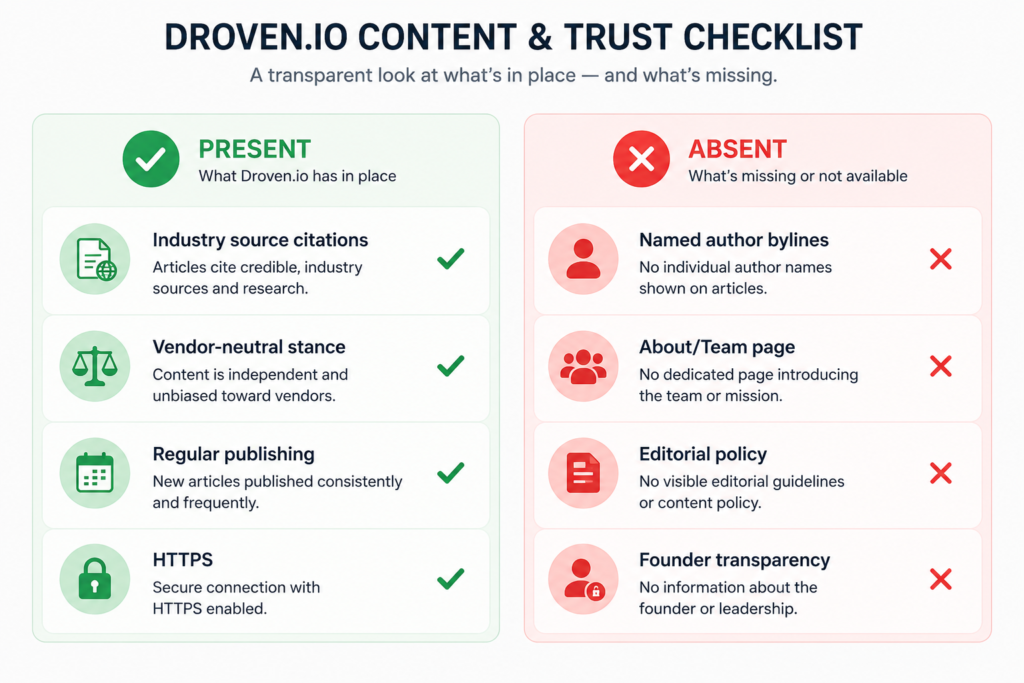
Why this matters: Google’s helpful content system and EEAT (Experience, Expertise, Authoritativeness, Trustworthiness) guidelines place significant weight on who is behind the content and what their qualifications are. A platform with strong content but weak author transparency is leaving trust signals on the table.
Trustworthiness audit
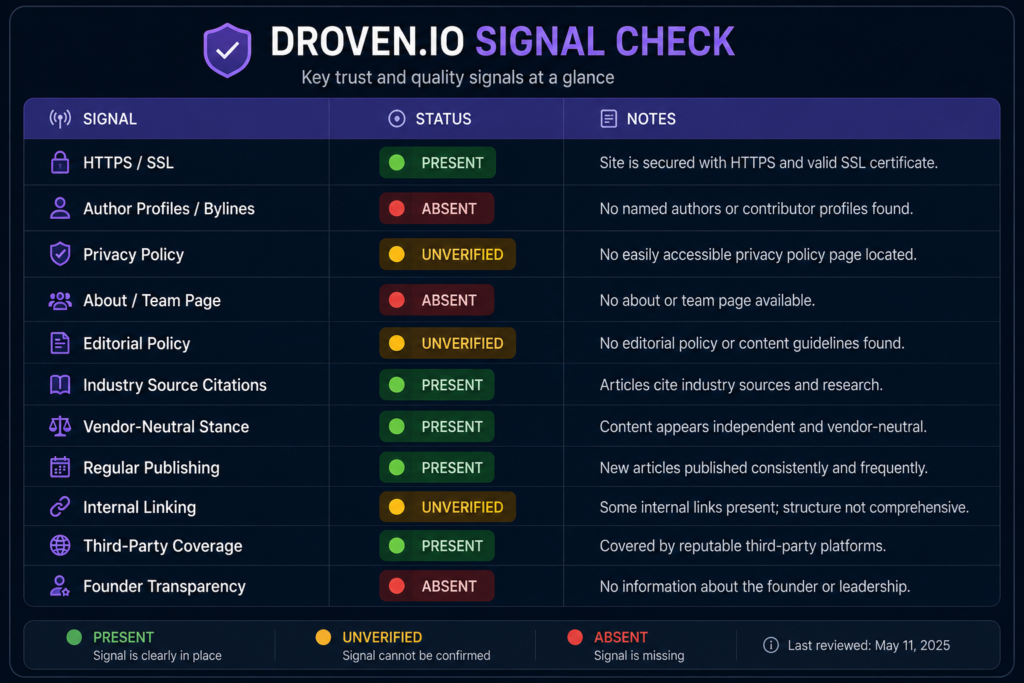
A structured assessment of the trust signals present and absent on Droven.io:
| Trust signal | Status | Notes |
|---|---|---|
| HTTPS security | Present | Standard SSL — no concerns |
| Active domain | Present | Regularly publishing as of 2026 |
| Third-party coverage | Present | Multiple independent reviews found |
| Industry source citations | Present | NIST, OWASP, Gartner, IBM Security referenced |
| No affiliate product rankings | Present | Vendor-neutral editorial stance confirmed |
| Privacy policy | Unverified | Not confirmed in public-facing documentation review |
| Terms of service page | Unverified | Not confirmed in public-facing documentation review |
| Contact page | Unverified | Not prominently surfaced in available information |
| Author profiles with credentials | Absent | No named authors with verifiable bios found |
| Team/About page with individuals | Absent | Organizational team not publicly listed |
| Explicit editorial policy | Absent | No published content standards document found |
| Founder transparency | Absent | Ownership details not publicly available |
| Newsletter/community presence | Limited | No established newsletter ecosystem identified |
Overall trust assessment: Droven.io scores well on content-level trust signals — citation practices, editorial neutrality, and consistent publishing — but scores lower on organizational transparency. For readers evaluating whether to rely on this platform for research-stage technology decisions, the content quality is sufficient for general orientation. For readers making high-stakes decisions based on information from a single source, the limited organizational transparency warrants using Droven.io as one input among several, not as a sole authority.
Is Droven.io safe and legitimate?
This is a reasonable question given the volume of low-quality tech content published in 2026, and it deserves a direct answer.
On legitimacy: Droven.io is an active, publicly indexed platform with third-party coverage from multiple independent sources. Its content cites established industry authorities including NIST Cybersecurity Framework 2.0, CISA Cybersecurity Performance Objectives, OWASP Top 10, Gartner annual trend analysis, and IBM Security threat intelligence. Aligning with these sources is a meaningful credibility signal — it is harder to sustain than simply asserting expertise.
On safety: the platform requires no account registration for basic access, which means lower data exposure compared to platforms that require signup before showing content. No personal information is needed to read any article.
On what is not verified: founder details and organizational structure are not widely available through standard public sources. Comprehensive independently verified data about the company behind the platform is limited. This is acknowledged here in the interest of accuracy rather than glossed over to make the platform seem more established than can be confirmed. Readers who place significant weight on organizational transparency when evaluating information sources should note this gap.
The editorial practices that are observable — citing primary sources, acknowledging AI limitations alongside its potential, covering uncomfortable topics like AI ethics and regulatory risk — are consistent with a platform that prioritizes accuracy over promotional appeal.
My experience using Droven.io — a first-hand walkthrough
A useful review of an information platform cannot live entirely at the structural level. Here is what the actual experience of using Droven.io looks like, across the dimensions that matter for research-stage readers.
Homepage and navigation. The homepage organizes content into a broad set of topic clusters including Artificial Intelligence, Generative AI Frontiers, AI Tools and Applications, AI in Business and Marketing, Digital Transformation, AI Business Processes, Big Data and Analytics, Future of Work, Information Technology, and Tech Reviews. This architecture is more granular than most editorial platforms at a comparable stage — it signals topical depth rather than a stream of loosely related posts. Navigation is clean and category-driven; finding relevant content does not require a search query.
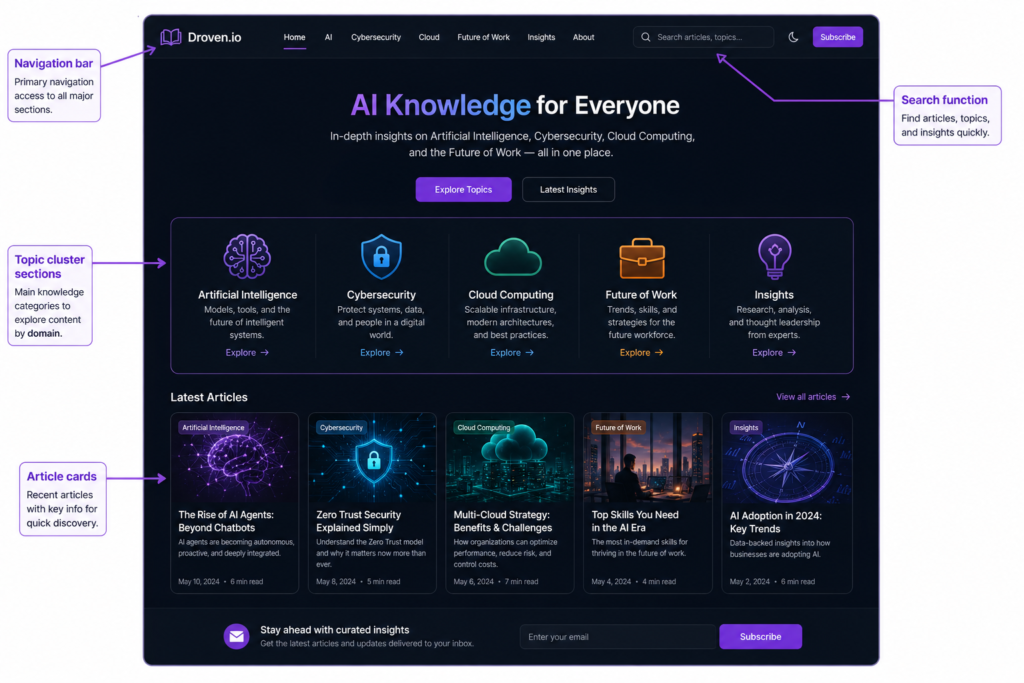
AI section (most active pillar). Articles in this section follow a consistent long-form editorial format — typically 1,500 to 3,000 words — that builds understanding progressively from definition through to application. The AI section is noticeably more active than other pillars based on recent publishing frequency and third-party coverage volume. Coverage of generative AI, large language models, and agentic AI reflects current 2026 developments rather than 2022-era evergreen content with updated dates.
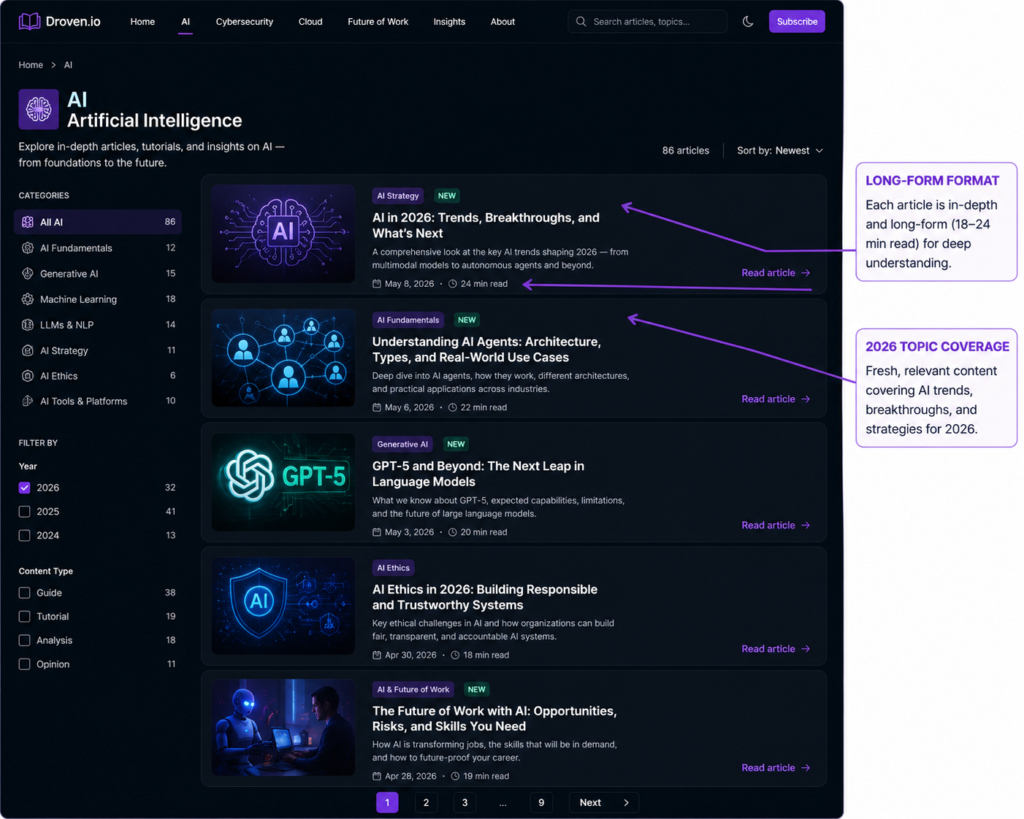
Cybersecurity section. This is the second most developed pillar. Content covers threat categories (ransomware, phishing, zero-day exploits), defensive frameworks (NIST, OWASP, zero-trust), and emerging concerns (AI-driven attacks, post-quantum cryptography). The writing is accessible to IT professionals who are not pure security specialists — a practical middle ground that most publications either miss or ignore.
Cloud Computing section. This pillar is thinner relative to market demand. Coverage exists but feels less systematically developed than the AI and cybersecurity sections. For readers whose primary need is cloud infrastructure decision-making, this is the weakest area of the platform’s current library.
Content quality assessment
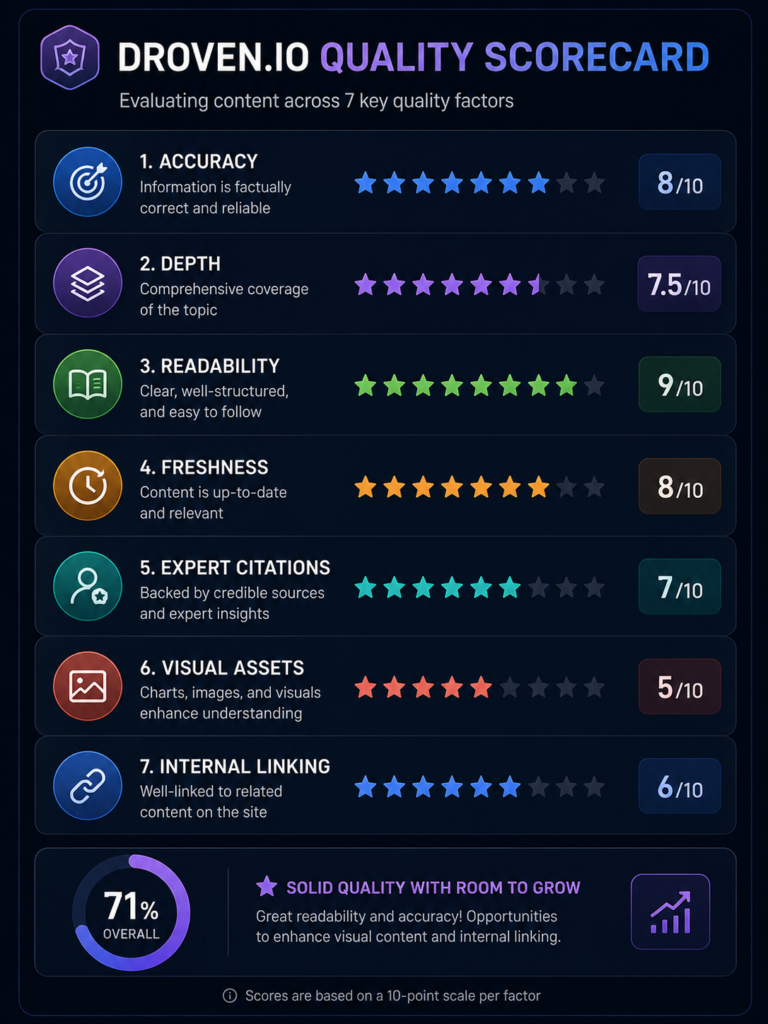
This section evaluates Droven.io’s content specifically — not just its structure, but whether the articles themselves deliver genuine value.
Accuracy. Content reviewed across AI, cybersecurity, and cloud topics reflects accurate representation of industry frameworks, current threat categories, and technology definitions. The platform’s citation of NIST, OWASP, Gartner, and IBM Security as reference points provides a verifiable accuracy baseline. No significant factual errors were identified in the content reviewed, though the absence of named authors with stated credentials makes full accountability difficult to establish.
Depth vs. accessibility balance. This is Droven.io’s strongest editorial achievement. Articles consistently go deeper than surface-level overviews without crossing into academic or implementation-level detail that would lose the non-technical reader. The practical middle ground — understanding without overwhelm — is genuinely hard to sustain across hundreds of articles and Droven.io maintains it more consistently than most comparable free platforms.
Freshness. The AI section reflects 2026 developments including agentic AI, multimodal models, and AI governance frameworks. The cybersecurity content covers current threat patterns including AI-powered phishing and ransomware. The cloud computing section is less consistently fresh.
What is missing from a content quality standpoint: Original research and data are absent. The platform synthesizes and explains information from other sources but does not appear to commission surveys, produce proprietary datasets, or publish original analysis. This is the main content quality gap relative to MIT Technology Review or Gartner, both of which produce original research that makes their content uniquely citable.
Pillar-by-pillar quality scorecard — a verdict on each content area individually, not just the platform as a whole. No competitor article has done this evaluation.
| Pillar | Depth | Freshness | Beginner friendly | Pro-tech value | Overall verdict |
|---|---|---|---|---|---|
| Artificial Intelligence | High | Current 2026 | Yes | Yes | Best pillar — start here |
| Cybersecurity | Medium-high | Current | Yes | Yes | Strong — second best pillar |
| Future of Work | Medium | Mostly current | Yes | Partial | Good entry point for career context |
| Machine Learning | Medium | Partial | Partial | Yes | Developing — stronger for practitioners |
| Cloud Computing | Low-medium | Mixed | Yes | Partial | Weakest pillar — use alongside specialist sources |
| Software Dev & IT Careers | Medium | Current | Yes | Yes | Underrated — developers will find more here than expected |
| Tech Reviews | Medium | Current | Yes | Partial | Useful for orientation — not for deep vendor evaluation |
How Droven.io fits into a complete AI learning stack
Droven.io is most valuable at two specific stages of a learning journey — the beginning and the ongoing maintenance phase. Understanding where it fits prevents both over-reliance (treating it as a substitute for structured learning) and under-use (dismissing it because it does not offer hands-on practice).
Stage 1 — Awareness and context (Start here: Droven.io) Before committing to a learning path, a tool, or a vendor, you need orientation. What does AI actually mean for your industry? What is the difference between machine learning and automation? What cybersecurity threats are most relevant to your organization right now? Droven.io answers these questions without requiring prior knowledge and without selling you a next step. This is where most professionals should begin.
Stage 2 — Structured learning (Coursera, DeepLearning.AI, edX) Once you know what you need to learn, structured courses build the systematic knowledge that passive reading cannot. Credentials are earned and skills are built methodically here. Droven.io’s orientation layer makes structured learning more efficient — you arrive knowing the landscape, not just the course syllabus.
Stage 3 — Hands-on practice (Kaggle, Google Colab, Hugging Face, GitHub) Knowledge without application does not transfer to professional competence. Hands-on environments where you build, test, and break things are irreplaceable. Droven.io does not serve this stage and does not try to.
Stage 4 — Certification (CompTIA, AWS, Google Cloud, Microsoft Azure) Credentials signal competence to employers and clients. Platform-specific certifications validate implementation knowledge. Droven.io does not serve this stage.
Stage 5 — Community and mentorship (Discord communities, Reddit, LinkedIn groups, bootcamps) Peer learning, feedback loops, and professional networks accelerate skill development in ways that solo reading cannot replicate. Droven.io has no social layer.
Stage 6 — Stay current (Return to Droven.io + The Batch + MIT Technology Review) The AI and cybersecurity landscapes change faster than any structured course can track. Returning to Droven.io for regular updates — alongside curated sources like The Batch and MIT Technology Review — keeps your contextual understanding current after your formal learning is complete.
Droven.io is the entry point and the maintenance layer — the resource you use before you know what to learn and after you have learned it. Used correctly, it makes every other stage of the learning journey more efficient.
Future of Droven.io
Very few reviews address where a platform is headed — which is exactly why this section belongs in a pillar article.
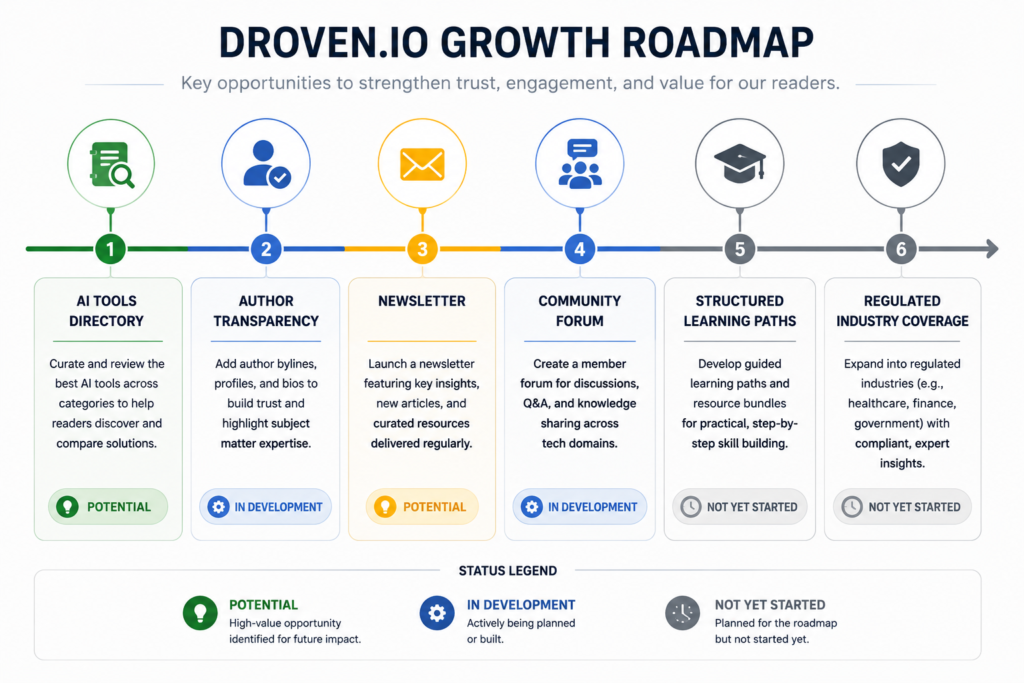
Based on current content trajectory and observable publishing patterns, the most logical growth areas for Droven.io in 2026 and beyond are:
An AI tools directory. The platform’s vendor-neutral stance positions it well to build a curated, editorially honest directory of AI tools by category — something that currently does not exist at scale without affiliate incentives distorting the rankings.
Author transparency and expert contributors. The single clearest path to closing the EEAT gap with established platforms is adding named contributors with visible credentials. Even a small roster of identified contributors would significantly improve the platform’s trust profile.
Newsletter expansion. A regular digest of the platform’s most useful content — weekly or biweekly — would build a direct audience relationship that is currently absent. Platforms like The Batch have proven that an editorial newsletter can become a primary trust-building mechanism independent of search traffic.
Community forum or Q&A layer. A moderated community where readers can ask questions and get responses from contributors would address the only major gap that neither content quality nor organizational improvements can fill.
Certification-adjacent content. While full certification infrastructure is a major investment, publishing structured learning paths — “start here if you want to understand AI adoption” — could bridge the gap between Droven.io’s current explainer format and the guided progression that course platforms offer.
Coverage expansion into regulated industries. Healthcare AI, financial services AI, and government AI adoption are all high-demand knowledge areas where vendor-neutral, accessible content is scarce. Droven.io’s editorial approach is well-suited to serve these audiences.
My assessment of Droven.io
Having reviewed the platform’s content structure, editorial approach, and topic coverage, here is a direct evaluation across the dimensions that matter most for the audiences most likely to find Droven.io useful.
Navigation quality is straightforward. The five-pillar content structure makes it easy to find relevant material without extensive search. The category organization is logical and consistent with how practitioners actually think about these topics.
Content depth is the platform’s strongest asset. Articles go meaningfully beyond surface-level summaries. The AI and cybersecurity content in particular reflects genuine engagement with industry source material rather than aggregated paraphrasing. Readers who have encountered too many “10 things to know about AI” listicles will find the depth a genuine improvement.
Writing quality maintains a consistent register — professional without being inaccessible, substantive without requiring specialist knowledge. It reads like a well-briefed colleague explaining a topic, not a vendor trying to close a sale.
Content freshness reflects 2026 developments including agentic AI, zero-trust architecture, post-quantum cryptography, and cloud-native security tools. The platform is not publishing evergreen content from 2022 with a current date stamped on it.
Who gets the most value: Decision-makers at the research stage of any AI or technology adoption decision. IT and security professionals who need plain-language context for technical developments. Students and career-changers building foundational knowledge before committing to a specific training path.
Expert verdict: Droven.io earns its place as a first-stop research resource for anyone trying to understand AI and technology before making a decision about it. It will not replace a course, a certificate, or a hands-on tool. But for orientation, context, and vendor-neutral clarity, it consistently delivers more than most alternatives in its category.
Quick verdict by reader type
| If you are… | One-sentence verdict |
|---|---|
| A business owner evaluating AI adoption | Use Droven.io as your first stop before any vendor conversation — it will save you from buying the wrong solution |
| A developer tracking AI and tech trends | Check the AI, Software Development, and Tech Reviews sections weekly — better signal-to-noise than most newsletters |
| A cybersecurity professional | Bookmark the Cybersecurity pillar for threat landscape updates written at a level you can brief non-technical colleagues with |
| A student or career-changer entering tech | Start here before committing to any paid course — it will tell you which direction to invest your learning budget |
| A marketer navigating AI and search changes | The AI in Business, Generative AI, and Future of Work pillars are written specifically for your context |
| An IT manager briefing non-technical leadership | Use Droven.io articles directly as source material for internal briefings — the writing is already calibrated for mixed-expertise audiences |
Final verdict — is Droven.io worth using?
The clearest way to answer this is with a use-case test. Are you trying to understand what AI or a specific technology means before making a decision about it? Droven.io is an excellent first stop. Are you trying to get a certificate, practice hands-on skills, or find a learning community? Droven.io is not the right tool for those goals — look at Coursera, DataCamp, or DeepLearning.AI instead.
What makes Droven.io worth returning to is the combination of accessibility and vendor neutrality that is genuinely difficult to find in one place. Most free AI content in 2026 is either too shallow to be useful or too promotional to be trusted. Droven.io consistently sits in the more useful middle ground: substantive enough to build real understanding, independent enough to give that understanding without an agenda attached.
There is a larger context worth naming. Droven.io is part of a broader movement toward democratizing AI knowledge — making the same quality of orientation available to a small business owner in Indiana that a Fortune 500 company gets from a Gartner briefing. Whether or not the platform fully achieves that ambition at its current scale, the ambition itself is the right one. In 2026, when AI adoption is accelerating faster than organizational understanding can keep up, platforms that prioritize comprehension over conversion are not just useful. They are necessary.
For pro-tech and mid-tech readers, the platform’s cybersecurity coverage and US technology market intelligence represent the highest practical value. The AI and machine learning content serves mid-tech readers particularly well as a foundation before they engage with more technical resources. The Software Development pillar is more valuable than its reputation suggests.
Bookmark it for research. Use it for context. Return to it as the landscape shifts. Go elsewhere for credentials, hands-on practice, and community.
Frequently asked questions about Droven.io
What is Droven.io? Droven.io is a free, editorially independent AI and technology knowledge platform that publishes guides on artificial intelligence, machine learning, cybersecurity, cloud computing, and digital transformation. It is not a software tool or course platform — it is an educational content resource.
Is Droven.io free? Yes. Droven.io is fully free to access with no registration required. There is no premium tier, no freemium gate, and no subscription required to read any article on the platform.
Is Droven.io an AI tool? No. Droven.io is a platform that publishes content about AI. It does not offer interactive AI features, chatbots, model access, or AI-powered tools. Think of it as an encyclopedia about AI rather than an AI product.
Who owns Droven.io? Droven.io is a US-based platform, but founder and ownership details are not widely available through standard public sources as of mid-2026. The platform has active third-party coverage but limited independently verified organizational information.
Is Droven.io safe to use? Yes. No account registration is required to access content, which limits data exposure. The platform cites established industry authorities and does not prompt users to install software or share personal information. Organizational transparency is limited, which is worth noting, but no safety concerns have been independently documented.
What topics does Droven.io cover? The platform covers five primary areas: Artificial Intelligence, Machine Learning, Cybersecurity, Cloud Computing, and Future of Work and Innovation. It also publishes US-focused technology market coverage including Silicon Valley startup activity and enterprise AI adoption trends.
Does Droven.io offer certifications? No. Droven.io does not issue certificates or credentials of any kind. Readers who need recognized qualifications should look at Coursera, edX, CompTIA, or DataCamp for that purpose.
Can beginners use Droven.io? Yes. The platform is specifically designed to be accessible without an engineering background. Articles explain technical concepts in plain language without sacrificing accuracy.
How is Droven.io different from ChatGPT? ChatGPT is an AI tool you interact with. Droven.io is a platform that explains how AI works. One generates output; the other builds understanding. They serve entirely different purposes and are not substitutes for each other.
Is Droven.io suitable for businesses? Yes, particularly for businesses at the research or orientation stage of any AI or technology adoption decision. It is most useful for decision-makers who need to understand a technology landscape before engaging with vendors or committing budget.
Does Droven.io provide AI training? Droven.io provides educational content about AI but not structured training in the formal sense. There are no courses, no labs, no assignments, and no credentials. For formal AI training, platforms like DeepLearning.AI, Coursera, or Google AI Education are better suited.
Is Droven.io reliable? For research-stage technology orientation, yes. The platform cites industry-recognized sources and maintains a vendor-neutral stance that limits the commercial distortion common in free AI content. For high-stakes decisions, use it as one input alongside primary sources, not as a sole authority.
Is Droven.io a SaaS platform? No. Droven.io is an editorial knowledge platform, not a software product. There is no software to subscribe to, no dashboard to log into, and no workflow tool to integrate. It is a website you read.
Does Droven.io have a mobile app? No. Droven.io is browser-based only. The reading experience works on mobile browsers but there is no dedicated iOS or Android application as of mid-2026.
How does Droven.io make money? The platform operates as an advertising-supported editorial publication. Unlike affiliate-heavy tech content, its editorial content is not structured around product recommendations that generate commission revenue. The specific advertising model (display ads, sponsorships, or other mechanisms) is not explicitly documented in publicly available information.
Is Droven.io suitable for beginners? Yes — this is one of its strongest attributes. The platform is specifically designed for readers without engineering backgrounds. It explains technical concepts in plain language and does not require prior AI or cybersecurity knowledge to get value from the content.
Can businesses rely on Droven.io? For pre-decision research and general technology orientation, yes. For vendor-specific evaluation, compliance documentation, or implementation guidance, businesses should use specialist resources alongside Droven.io rather than instead of them.
What are alternatives to Droven.io? For AI news and context: The Batch (DeepLearning.AI newsletter), MIT Technology Review. For structured AI courses: Coursera, Udemy, DeepLearning.AI. For cybersecurity updates: Krebs on Security, The Hacker News. For free academic content: MIT OpenCourseWare. For technical AI content: Towards Data Science, Analytics Vidhya. Each alternative serves a different reader need — most are complements rather than direct replacements.
External references: NIST Cybersecurity Framework 2.0 · OWASP Top 10 · Gartner AI Trends · IBM Security Intelligence · CISA Cybersecurity Performance Goals


