
Blockchain’s functionality goes beyond cryptocurrency, and one of its most practical applications is protecting intellectual property.
Blockchain’s functionality goes beyond cryptocurrency. The technology has advanced to be used to store records in areas such as the medical field and notaries, and one of its most practical applications is intellectual property. In 2026, that application looks less like a novelty and more like infrastructure: real courts have ruled on blockchain-recorded evidence, real platforms exist for creators and companies to use today, and international standards bodies are actively working on frameworks for it. This piece covers both sides of that honestly — what blockchain actually does well for IP, and where it still falls short of a real legal right.
Blockchain and IP protection, at a glance
Before going deeper, here’s the short version.
| What it does | Creates a timestamped, tamper-evident record of when a file existed and who held it |
| What it doesn’t replace | Formal registration with a patent, trademark, or copyright office — or advice from an IP attorney |
| Best used for | Establishing prior art, proving authorship, and automating licensing or royalty payments |
| Market context | One industry estimate sizes blockchain-specific IP protection tools at roughly $981 million in 2025, projected toward $4.9 billion by 2032 |
Blockchain and intellectual property
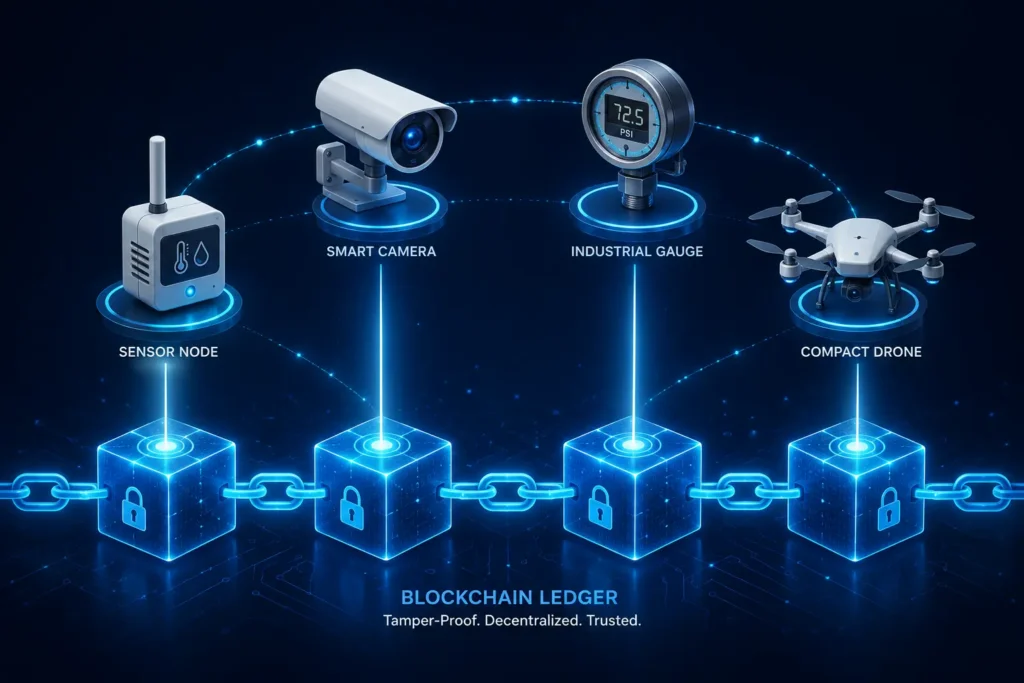
Blockchain protects intellectual property by creating a timestamped, tamper-evident record of who created something and when. Its immutable nature provides a history of ownership and creation that’s difficult to tamper with, which matters to an IP owner because it prevents a claim to ownership from being contested by another party after the fact. Using smart contracts alongside blockchain adds a further layer of security, and can be used to issue licenses or collect royalties automatically. Blockchain is also a useful strategy to pair with the Internet of Things (IoT), helping ensure that data generated by connected devices stays protected.
Blockchain is a valuable strategy to implement with IoT technology in the intellectual property field to ensure data is protected.
If you decide to store your intellectual property data using blockchain, it’s still worth retaining professional counsel trained in IP law. A blockchain record is strong supporting evidence, not a substitute for a lawyer — if someone infringes on your work or contests your ownership, counsel can guide you through evidence-gathering and litigation.
How blockchain applies to each type of IP
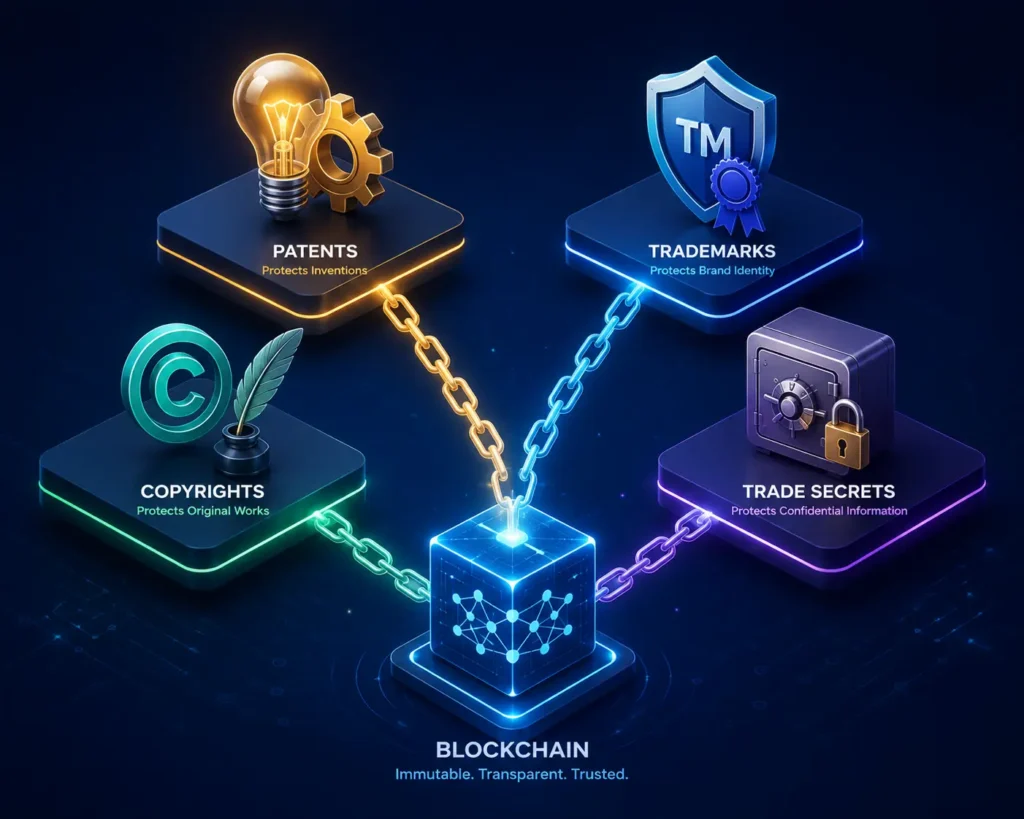
Blockchain doesn’t work the same way for every kind of intellectual property. Here’s how it actually applies across the four main categories.
Patents
A patent protects an invention and gives its owner the exclusive right to make, use, or sell it. Blockchain’s role here is narrow but useful: a timestamped record can establish when an idea or design existed, which matters in a prior-art dispute over who invented something first. What it can’t do is grant you a patent. Patent rights only come from filing with a patent office and going through examination — a blockchain timestamp is evidence you can bring to that process or to a later dispute, not a substitute for it.
Trademarks
Trademarks protect the names, logos, and symbols a business uses to identify itself. Blockchain can record the date a mark was first used in commerce, which is relevant in disputes over who used a name first. Some platforms now let businesses convert a registered trademark into a token, so ownership and licensing terms can be transferred on-chain — though, as covered further down, that token proves a transaction history, not legal title.
Copyrights
Copyright is the category blockchain fits most naturally, because copyright protection exists automatically at the moment a work is created — there’s no filing requirement in most countries for the underlying right to exist, even though registration still matters for enforcement in places like the US. That makes a blockchain timestamp genuinely useful: it’s a public, checkable record of when a photograph, song, piece of software, or written work existed in a specific form, which is exactly the kind of evidence a copyright dispute turns on.
Trade secrets
Trade secrets are the odd one out, and it’s worth being honest about why. A trade secret’s entire value depends on it staying secret — the moment you publish something to a public, permanent ledger, you’ve arguably undermined the thing you’re trying to protect. Some platforms address this by anchoring only a cryptographic hash of the secret material, not the material itself, which proves you possessed the file without revealing its contents. That’s a reasonable workaround, but it’s worth understanding the trade-off rather than assuming blockchain is a natural fit here the way it is for copyright.
Implementing blockchain: the tamper-proof evidence chain
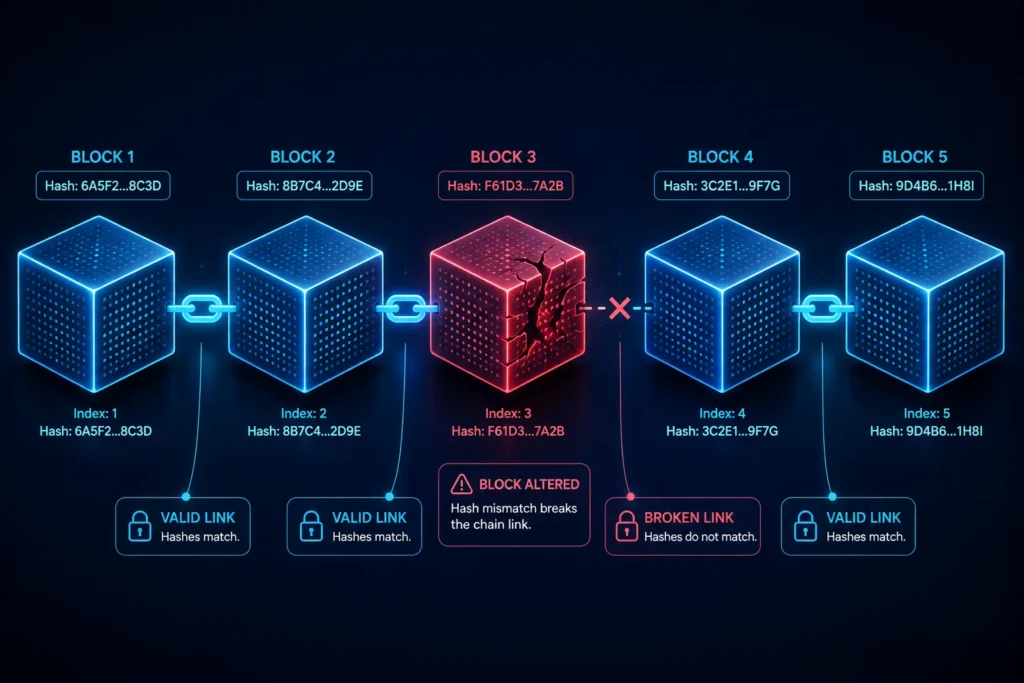
Implementing blockchain allows for a tamper-proof chain of evidence for copyright ownership. If someone were to change the data stored in a block, the hash value of that block would change — but the next block in the chain would still retain the original hash value linking back to it. Changing the linking hash changes that block’s hash value as well, which means that unless someone can edit every block on the chain with new, matching hash values, the data stored on a block effectively can’t be changed. The computing power required to alter every block’s hash makes this vanishingly unlikely, which is what makes blockchain a reliable way to store copyright information.
Along with being tamper-proof, blockchain provides a way to trace the ownership of a work over time. The original creation date can be stored in a block’s data, so if your ownership is ever contested, that data can serve as evidence to prove it. Being able to trace ownership this way saves time and resources during evidence-gathering if litigation is ever pursued, since third parties can view the chain of ownership directly. The same approach can be used to catalog original works or show a filing date for patents or trademarks — and because the record isn’t tied to a single national office, it can be stored and verified internationally rather than only through one country’s patent office.
Turning IP into a tradeable asset: NFTs
One extension of this idea is using NFTs (non-fungible tokens) to represent ownership of a trademark or patent, so the right can be transferred, licensed, or even split among multiple owners on-chain. Enterprise platforms now do this at scale — IPwe, for example, partnered with IBM in 2021 to tokenize patents as NFTs, and now maintains data on a large database of patents globally, letting large patent portfolios be bought, sold, or used as collateral. It’s worth being precise about what the NFT actually proves, though: it’s a record of on-chain transaction history — who transferred what to whom, and when — not a substitute for legal title. Legal ownership of the underlying patent or trademark still runs through the registration systems described above; the NFT sits on top of that, it doesn’t replace it.
Smart contracts and security
The addition of smart contracts has increased the utility of using blockchain to protect intellectual property. Smart contracts live on the blockchain and perform actions — like granting access to the information stored on a block — automatically, once certain conditions are met. Using this functionality, an owner can license their work to someone by accepting that person’s digital signature, or deny access to someone who doesn’t have one. Smart contracts can also be used to collect royalties from people using or accessing the IP, by setting the terms of that arrangement in the contract itself.
IoT devices may be considered to host intellectual property data of their own, but security remains a real concern there — cyberattacks are becoming more common, and data security is genuinely at risk. Using a private network to host IoT devices can help, but pairing that with blockchain adds another layer of protection: storing intellectual property on a blockchain means the data can’t be tampered with even if the surrounding system is compromised.
Blockchain and IP protection for IoT specifically
That IoT connection is worth taking further, because it’s the angle most general explanations of blockchain and IP skip past entirely. A few concrete places it shows up:
Firmware and embedded software IP
Device manufacturers can timestamp firmware builds and version releases as they ship them, creating a record of authorship that’s useful if a competitor reverse-engineers a product, or if a supplier or contractor later disputes who actually wrote a given piece of embedded code.
Sensor and device-generated data ownership
A connected device generates a continuous stream of data once it’s deployed, and it’s not always obvious who owns that stream — the manufacturer, the operator, or whoever’s pipeline it eventually lands in. Timestamping and attributing a specific data stream to a specific device or owner before it gets pooled with other sources gives you something to point to later if that question comes up.
Edge AI model provenance
As more IoT products ship with on-device inference rather than calling out to the cloud, disputes are starting to come up over which version of a model actually shipped, and who trained it. Timestamping model versions at the point of deployment creates the same kind of provenance record used for other IP types, applied to a model instead of a document.
Automated licensing between devices
Smart contracts can let one company’s IoT platform pay per-use royalties to another company’s sensor or data feed automatically, without a manual licensing negotiation for every connection — useful when a product depends on dozens of small data or component licenses that would be impractical to renegotiate by hand.
Who’s already building this
On the institutional side, the World Intellectual Property Organization (WIPO) established a Blockchain Task Force in October 2018, operating under Task No. 59 of its Committee on WIPO Standards. As of its most recent public report, from September 2025, the Task Force is still active and working on a draft WIPO standard covering how blockchain technology can be applied across IP ecosystems — collecting information from national IP offices on their experience with blockchain, and developing reference models the field can use. The European Union Intellectual Property Office (EUIPO) has also expressed public interest in blockchain for IP registries. In practical terms, an operational system tends to break down into three functions: a registry that records the asset, an exchange that transfers it, and a payments layer that handles licensing revenue.
A correction worth making: WIPO PROOF is not blockchain
One thing worth clearing up directly, since it’s a common mix-up: WIPO did run a real digital-evidence service called WIPO PROOF, launched in 2020. It let anyone generate a timestamped digital fingerprint of a file as proof it existed at a specific point in time. But it wasn’t built on blockchain — the underlying verification is standard Public Key Infrastructure (PKI) timestamping, the same certificate-and-timestamp-authority approach used for RFC 3161 timestamps generally, not a distributed ledger. WIPO discontinued the service on January 31, 2022, following an internal budget and planning review. Tokens issued before that date remain valid indefinitely and can still be independently verified using open-source tools, but no new tokens can be created. If you see WIPO PROOF described as a blockchain product, that’s not accurate — it’s worth knowing the difference before citing it as an example of WIPO “doing blockchain.”
Named tools worth knowing
On the commercial side, a handful of platforms handle this for creators and companies today. Bernstein, based in Switzerland, anchors records to the Bitcoin blockchain and generates certificates formatted for legal proceedings; its published pricing starts at $54 a month for an individual plan, with higher tiers for teams. OriginStamp, running since 2013, anchors file hashes to Bitcoin, Ethereum, and Aion, and offers free timestamping for limited usage before paid tiers apply at higher volume. IPwe focuses specifically on enterprise patent portfolios, building on its 2021 IBM partnership to tokenize patents as NFTs. Pricing and feature sets in this space change often, so it’s worth checking each platform’s current terms directly rather than treating any of this as fixed.
Market context, and why 2026 is different from 2021
One industry market report sizes the blockchain-for-IP-protection segment specifically at roughly $981 million in 2025, projected to reach $4.9 billion by 2032 — worth treating as one industry estimate rather than a settled figure, since market-sizing methodologies vary. Separately, broader crypto infrastructure has matured in 2026: the US GENIUS Act, signed into law in July 2025, created the first federal framework for payment stablecoins, and several states have since added their own digital-asset licensing regimes. Neither of these regulates IP-tokenization tools directly, but they’re part of a broader shift toward blockchain-based tools being treated as regulated financial infrastructure in 2026, rather than the speculative framing that dominated during the NFT boom a few years earlier.
Where blockchain IP protection falls short
None of this makes blockchain a replacement for the legal system, and it’s worth being direct about where the limits actually are.
A blockchain record doesn’t carry independent legal weight the way a granted patent or a formally registered copyright does. A timestamp is evidence you can present, not a ruling — a dispute over who owns something still gets resolved by the same courts and IP offices it always has, blockchain record or not.
Jurisdiction is a real complication, too. Blockchain networks are inherently cross-border, but IP law isn’t; a dispute still lands in a specific country’s court system, and having a globally visible record doesn’t settle which country’s law actually applies to your case.
There’s also a genuine tension between the immutability that makes blockchain useful as evidence and how takedowns work. If a court orders infringing content removed, that content can still exist permanently on whatever chain it was anchored to — the record doesn’t disappear just because a court said it should. That’s worth knowing going in, rather than discovering it later.
Finally, there’s no single independent audit establishing that a blockchain timestamp carries the same evidentiary weight as formal registration in every jurisdiction. As the next section covers, courts in more than one country have accepted blockchain timestamps as evidence — but “accepted as evidence” and “carries the same legal weight as a granted patent” are different claims, and it’s worth not collapsing them into each other.
Has this actually been tested in court?
It has, in at least two notable cases worth knowing about — along with an honest caveat about what they do and don’t prove.
The first came from the Hangzhou Internet Court in China, in 2018, in a case brought by Huatai Media against Shenzhen Daotong Technology over unauthorized republication of copyrighted articles. It’s widely cited as the first court anywhere to formally admit blockchain-preserved records as evidence in a copyright case, and the ruling was significant enough that China went on to build blockchain evidence into procedural rules for its internet courts more broadly.
The second is more recent: on March 20, 2025, the Tribunal Judiciaire de Marseille in France (case RG 23/00046) ruled in a dispute involving the estate of fashion designer Alber Elbaz. Sketches uploaded to a blockchain timestamping platform in 2021 were presented as evidence of authorship and creation date for a set of fashion designs, and the court accepted the blockchain timestamp as valid proof of anteriority — meaning it helped establish that the designs existed, in that form, before the disputed use. This is confirmed directly on EUIPO’s own case-law summary page, not just in vendor marketing.
Here’s the honest caveat, drawn from independent legal commentary rather than the platforms that use this case in their own marketing: the underlying infringement in the French case was fairly clear-cut regardless of the blockchain evidence, so it’s not a clean test of whether blockchain evidence alone would carry a case that was genuinely contested on the facts. It’s also worth remembering that French copyright, unlike US copyright, doesn’t require formal registration for the underlying right to exist — so a French court accepting blockchain timestamps as supporting evidence doesn’t automatically tell you how a US court would treat the same evidence in a country where formal registration plays a bigger role.
The realistic takeaway: courts have accepted blockchain timestamps as evidence, which is a genuine and useful data point. They haven’t treated it as a replacement for the underlying legal framework — which is consistent with, not a contradiction of, the limitations above.
Blockchain vs. traditional IP registration
Given everything above, it’s worth putting the two approaches side by side rather than treating one as a replacement for the other.
| Factor | Traditional registration | Blockchain record |
| Cost | Filing fees, often plus attorney fees | Low — typically a small transaction fee |
| Speed to establish a record | Weeks to years, depending on office and IP type | Minutes |
| Global reach | Jurisdiction-specific; separate filings per country or region | Same record visible everywhere, but not automatically legally recognized everywhere |
| Legal enforceability | A formally recognized right, enforceable in court | Supporting evidence, not a standalone legal right |
| Tamper resistance | Paper or digital records held by a central office | Distributed — no single point of alteration |
| Requires a lawyer | Usually, especially for patents | Not to create the record, but still worth having before relying on it in a dispute |
Neither replaces the other. Blockchain works best as a fast, cheap, globally visible evidence layer that sits alongside formal registration, not instead of it.
Is blockchain worth using for your IP?
If you’re a creator or an IoT team that wants a fast, low-cost, internationally verifiable way to establish that something existed in a specific form on a specific date — before or alongside formal filing — blockchain timestamping is a genuinely useful tool, and one that’s now been tested in real courts rather than just proposed in theory.
It isn’t a substitute for anyone who needs an enforceable legal right. That still runs through a patent office, a copyright registration, or a retained IP attorney, the same way it did before blockchain entered the picture. Use blockchain to build your evidence trail. Don’t mistake it for the legal right itself.
Frequently asked questions
Is blockchain a legal substitute for a patent or copyright registration?
No. A blockchain record is evidence you can present in a dispute, not a legal right in itself. Patent rights only come from filing with a patent office; copyright exists automatically at creation in most countries, but formal registration still matters for enforcement in places like the US. Blockchain supplements these systems — it doesn’t replace them.
Can blockchain prove I created something first?
It can provide strong supporting evidence. A blockchain timestamp shows that a specific file, in a specific form, existed at a specific point in time — which is directly useful in a prior-art or authorship dispute. Courts in China and France have both accepted this kind of evidence, as covered above.
What is the WIPO Blockchain Task Force?
It’s a working group established by the World Intellectual Property Organization in October 2018, under Task No. 59 of its Committee on WIPO Standards, tasked with exploring blockchain applications for IP offices and developing a draft standard. As of its most recent public report, the Task Force is still active.
How do smart contracts handle IP licensing and royalties?
A smart contract can be set up to grant access to licensed material once a user provides a valid digital signature, and to automatically route royalty payments to the rights holder whenever the material is used or sold — removing the need for a manual licensing negotiation each time.
Can an NFT protect a trademark or patent?
An NFT can represent ownership of a trademark or patent and record its transfer history on-chain, which platforms like IPwe now do at scale for patent portfolios. But the NFT proves transaction history, not legal title — the underlying trademark or patent registration is still what establishes the actual legal right.
Does blockchain help protect IoT device data or firmware?
It can. Manufacturers can timestamp firmware builds to establish authorship, and companies can timestamp device-generated data streams to establish who owned a given data set before it was pooled with other sources. This is a newer, less-explored application than document or artwork timestamping, but the underlying mechanism is the same.
What happens if someone disputes a blockchain-recorded ownership claim?
The dispute still gets resolved through the normal legal system — a court or an IP office, not the blockchain itself. The blockchain record functions as evidence you bring to that process, similar to a notarized document or a dated deposit, rather than as a self-enforcing verdict.
Is blockchain-based IP protection recognized internationally?
There’s no single global standard yet, which is part of what WIPO’s Blockchain Task Force is working on. In practice, recognition currently happens case by case, court by court — as seen in the Hangzhou and Marseille rulings above — rather than through one unified international framework.
Has a court ever actually accepted blockchain evidence in an IP case?
Yes. The Hangzhou Internet Court in China accepted blockchain-preserved records in a 2018 copyright case, and the Tribunal Judiciaire de Marseille in France accepted a blockchain timestamp as valid proof of anteriority in a March 2025 ruling involving fashion designs. Both are covered in detail above, along with an important caveat about what they do and don’t establish.
Is WIPO PROOF built on blockchain?
No — this is a common mix-up. WIPO PROOF, WIPO’s own digital-evidence timestamping service, used Public Key Infrastructure rather than blockchain. It launched in 2020 and was discontinued on January 31, 2022, though previously issued tokens remain independently verifiable.


